November 8, 2026
Midterms sink chips, but the AI trade holds up
By Max Larsson@m_larsson on X
Democrats won both chambers of Congress on Tuesday, and on Thursday chip stocks had their worst day since March 2020 on fears of new AI rules. I think the market got that one badly wrong.
In short:
- The model reads Reflation with liquidity expanding. Inflation eased to +0.20 as pipeline costs cooled, while growth held at +0.67.
- The model portfolio rebalanced on Thursday toward growth and liquidity, cutting cash from 25% to 10%.
- My view is that the AI industry gets around new rules far more easily than a 12% drop in chip stocks suggests.
- Vance blaming the defeat on the war and the cost of living is, to me, the opening move for 2028.
The model this week
Reflation, with liquidity expanding. Liquidity turned on November 4 and has stayed there. Reflation has held since May 6.
Since Wednesday's letter, growth is up from +0.65 to +0.67, inflation is down from +0.29 to +0.20 and liquidity is down from +0.05 to +0.03. The history for November 4 moved by a hundredth or two since that letter as data was revised, so these changes are measured against today's history.
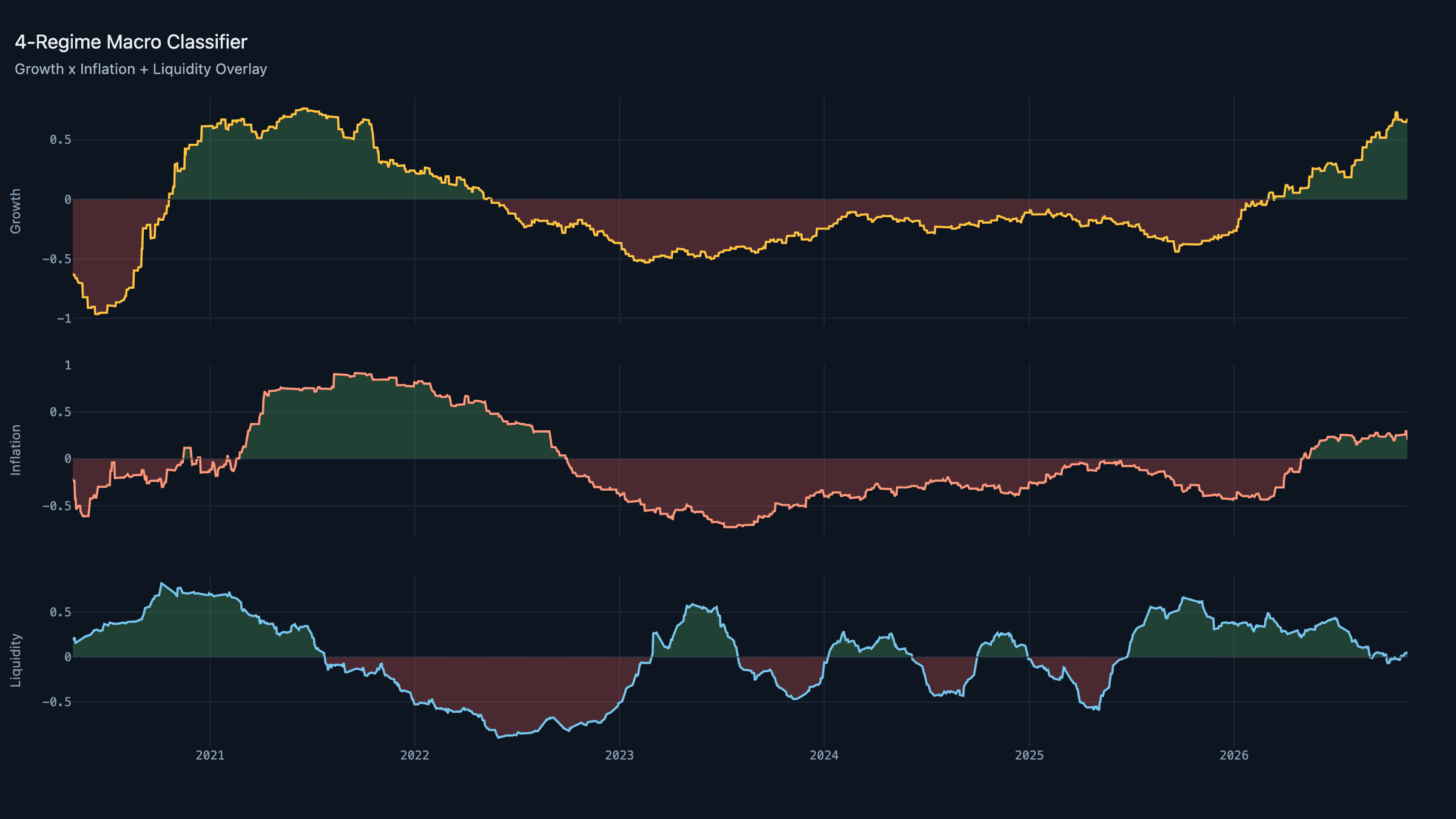
Inflation did the moving, and all of it came from pipeline costs, which track producer, energy, used-car and supply-chain prices. That pillar fell from +0.22 to +0.03 as new cost data landed. Demand is a different story. Demand pressure is still at +0.76, its highest since October 2021, so cost pressure is easing while demand stays hot.
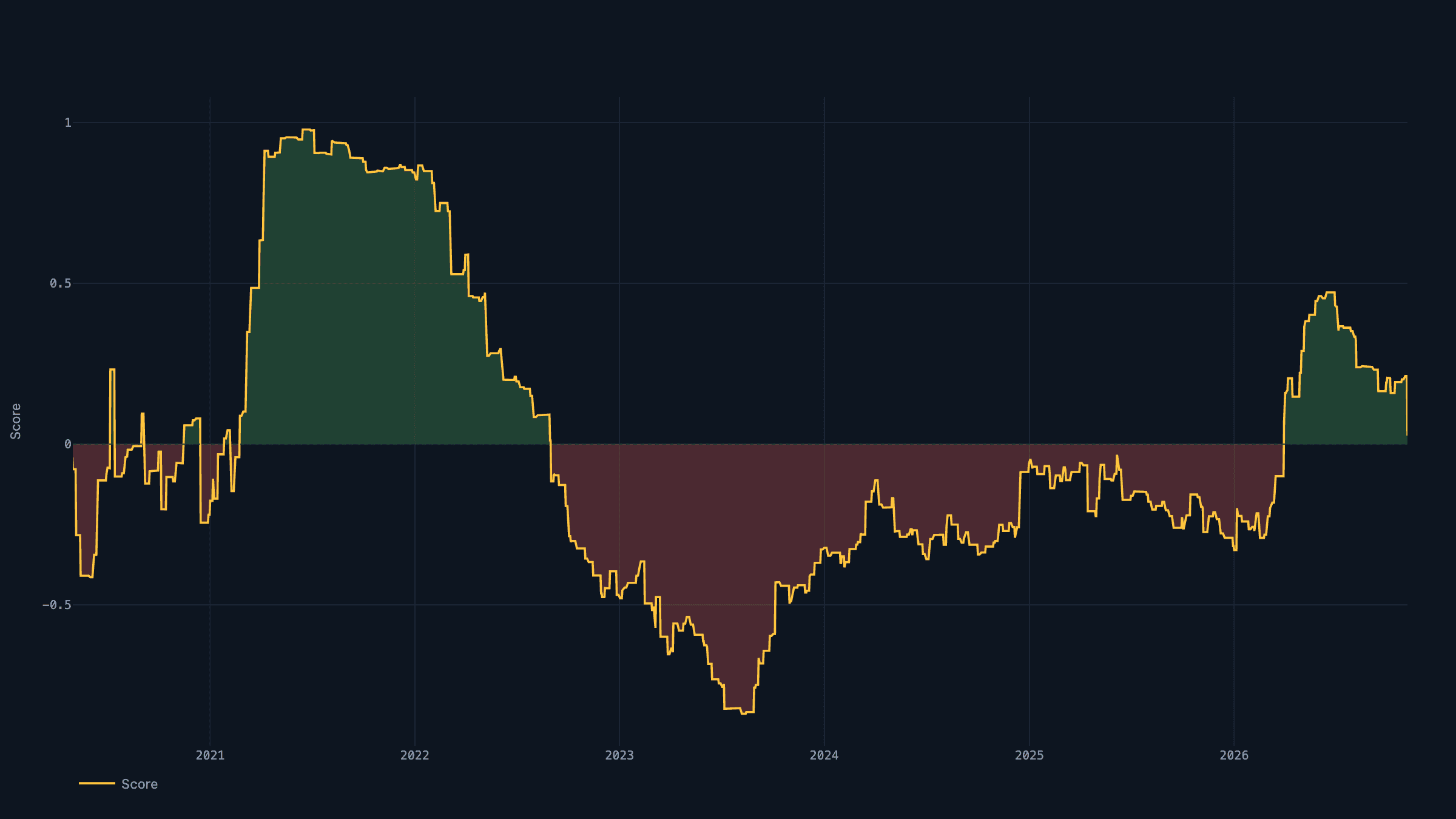
Growth edged up as distribution, which tracks goods and services reaching customers, rose to +0.57, also its highest since October 2021. Input acquisition, which reads Korean and Taiwanese exports, sits at +0.98, about as high as the scale goes (more on that below). Liquidity is close to zero but still reads expanding.
The liquidity turn triggered the rebalance on Thursday, November 5, and the next scheduled one is December 1. The model holds:
- Real assets 30%, with XLE (energy) and PDBC (broad commodities) at 15% each
- Growth 25%, with SMH (semiconductors) and SPY (S&P 500) at 12.5% each
- Liquidity 25%, with CPER (copper) and IEMG (emerging markets) at 12.5% each
- Cash 10%, all in SGOV (T-bills)
- Defensive 10%, with XLV (healthcare) and XLP (consumer staples) at 5% each
From November 4 through Thursday the simulated book fell 3.6%, against a 4.4% drop in the S&P 500. It now sits 6.1% below its simulated peak, while its worst drawdown (the biggest drop from a peak) since June 2020 is -9.4%.
A blue wave, with data centers on the ballot
Democrats took both chambers of Congress on Tuesday, with record turnout for a midterm. Republicans went in holding the Senate 53 to 47, and Democrats needed four seats to flip it. They got seven, including Texas, where James Talarico became the first Democrat to win a Senate seat since 1988, and South Carolina, where the party hadn't won one since 1998. They also took four governorships from Republicans, in Georgia, Ohio, Iowa and Texas.
AI turned out to be a much bigger issue than anyone priced in. Voters turned down data centers in 40 of the 41 local ballot measures about them, about half of those in Ohio, and in an NBC exit poll 56% of voters called AI and data centers a crucial or major factor in their vote.
The race that really spooked the market was Texas, which holds about a quarter of planned US data center capacity. Gina Hinojosa beat Greg Abbott for governor after promising a moratorium on data center approvals until the legislature passes new rules, and the new governors in Ohio and Georgia also ran against the buildout. Markets shrugged on Wednesday and panicked on Thursday, when the Philadelphia semiconductor index fell 12.3%, its worst day since March 2020.
The AI industry can afford Washington
Democrats will probably bring in more AI rules. But I think the industry gets around them a lot more easily than people expect, and it definitely didn't deserve a drop like that. Projects already under construction would reportedly be exempt from the Texas pause, and much of the capacity due in 2027 is already being built. The companies building out AI have trillions of dollars riding on it, and that buys a lot of influence in Washington. I expect lobbying to be peaking, and a few little league teams to suddenly get some very large sponsors.
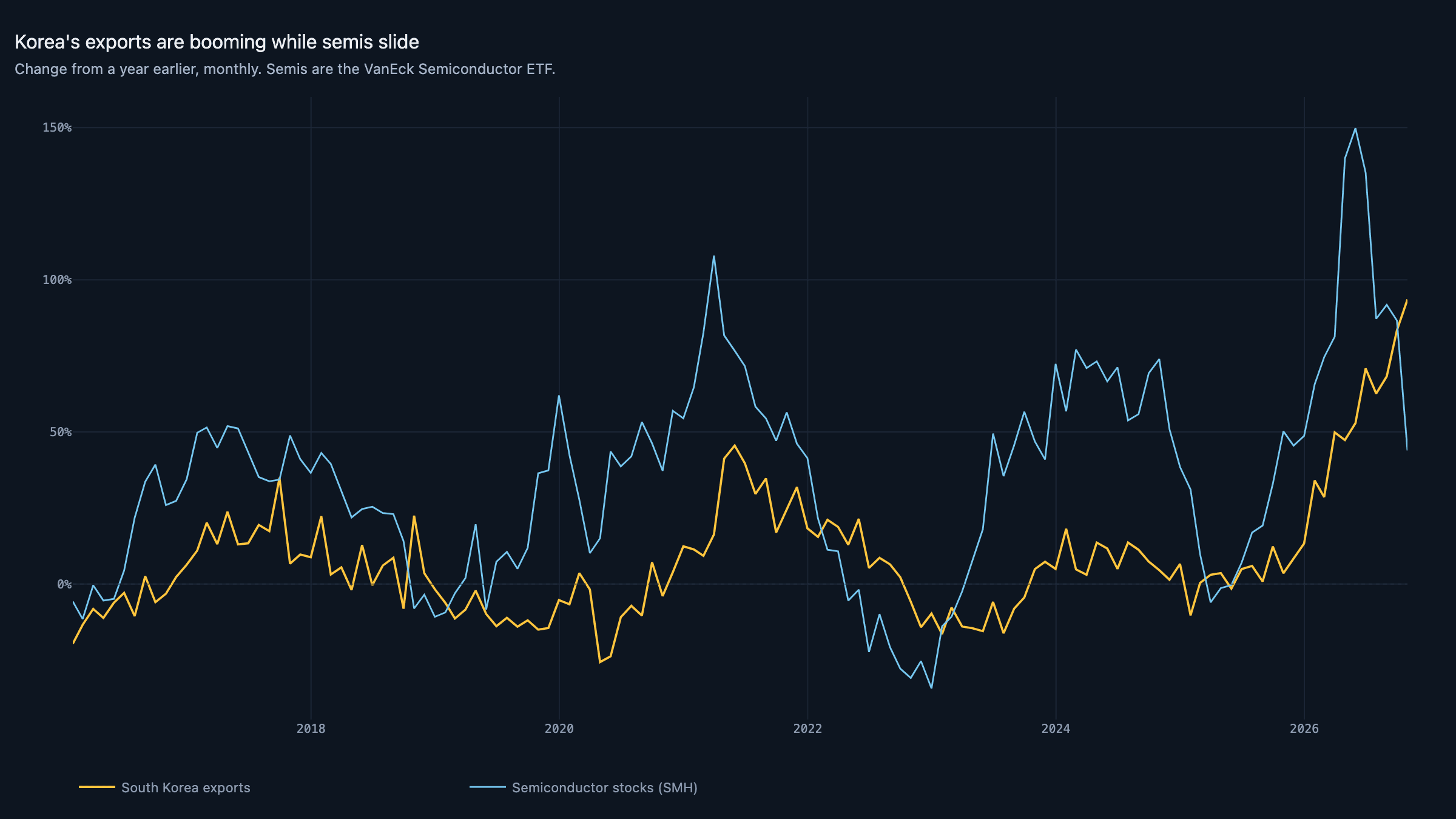
Backing this up, the best coincident indicator of the AI trade keeps rising. Korea's chip exports came in 259% higher than a year earlier in October, at $56.4 billion, almost half of everything the country shipped. Total exports nearly doubled, while chip stocks went the other way. It also shows up in the model, where input acquisition is pinned near the top of its range.
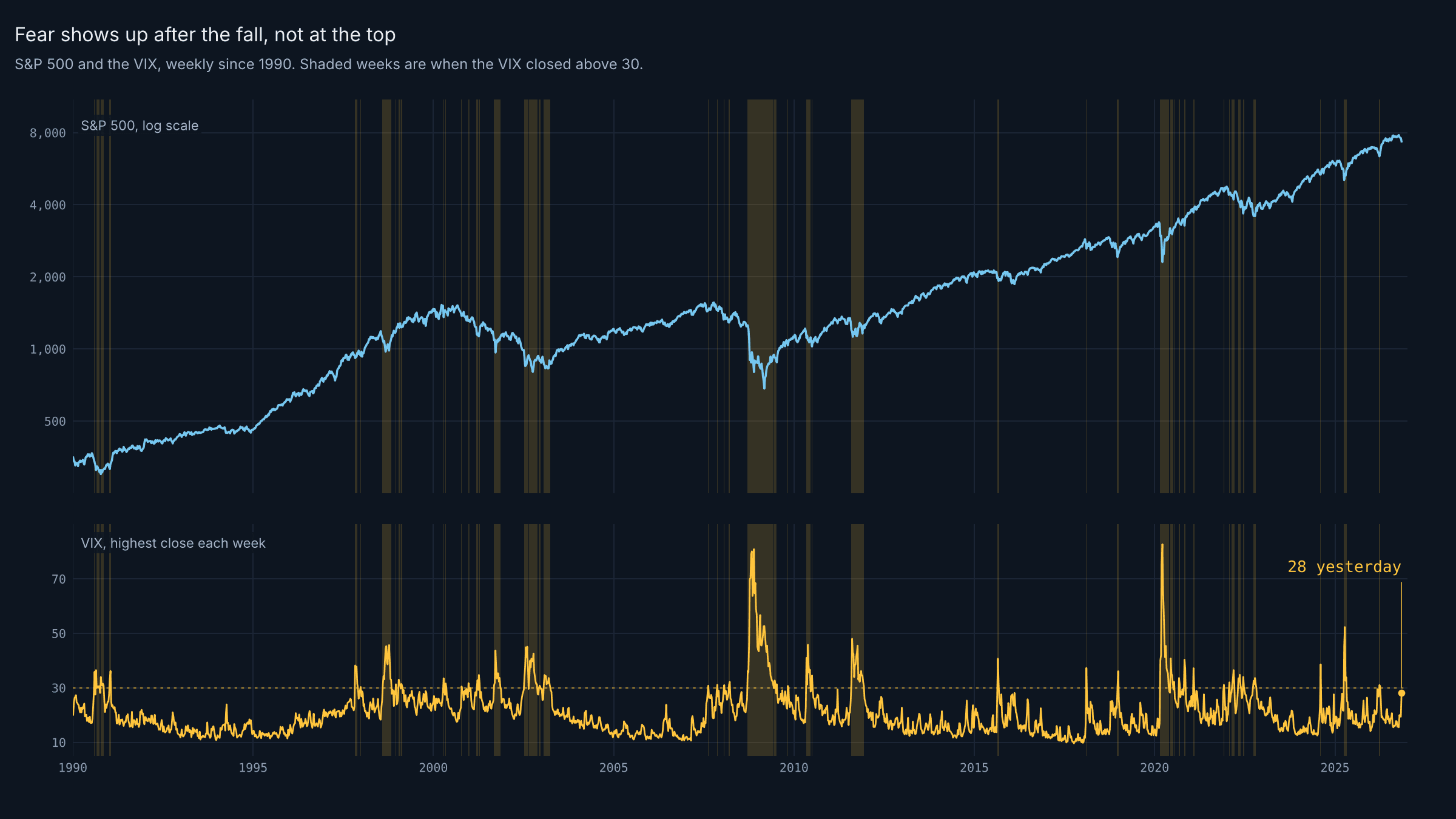
And just to calm your fears, the VIX jumped as much as 48% during Thursday's session, its biggest move since April 2025. A spike like that lines up with bottoms far more often than tops. Fear tends to show up after the fall, not at the top.
So chill out a bit. To me this should be treated like value, not a reason to sell.
My opinion, not model output and not a recommendation to buy or sell anything.
Vance starts on 2028 before the count is done
The blame game started before the last votes were in. Vice President JD Vance blamed the defeat on the Iran war, the cost of living and the relationship with Israel. Trump called that "largely true" while pinning more of it on gasoline prices. Voters themselves put their wallets first. In the AP's survey only about a third called the war crucial to their vote, against roughly half for the cost of living or corruption.
I read that as Vance setting up a 2028 takeover by going after the Trump decisions people feel in their wallets.
Week ahead
- Tue Nov 10, CPI (8:30 AM ET). Not a model input, but it matters for the Fed and can move real yields, which sit in liquidity's cost half.
- Thu Nov 12, weekly jobless claims (8:30 AM ET). They feed growth's distribution pillar, now at its highest since October 2021.
- Fri Nov 13, PPI (8:30 AM ET). Its consumer food prices feed pipeline costs, the pillar that pulled inflation down this week.
Model readings as of Friday, November 6, 2026. Scores run from -1 to +1, and above zero means above normal.
Get the next letter by email.
A free account gets the weekly letter in your inbox every Sunday, and every letter before this one. No card needed.