MacroScope Weekly, October 11, 2026
Current Regime: Reflation / Contracting Liquidity
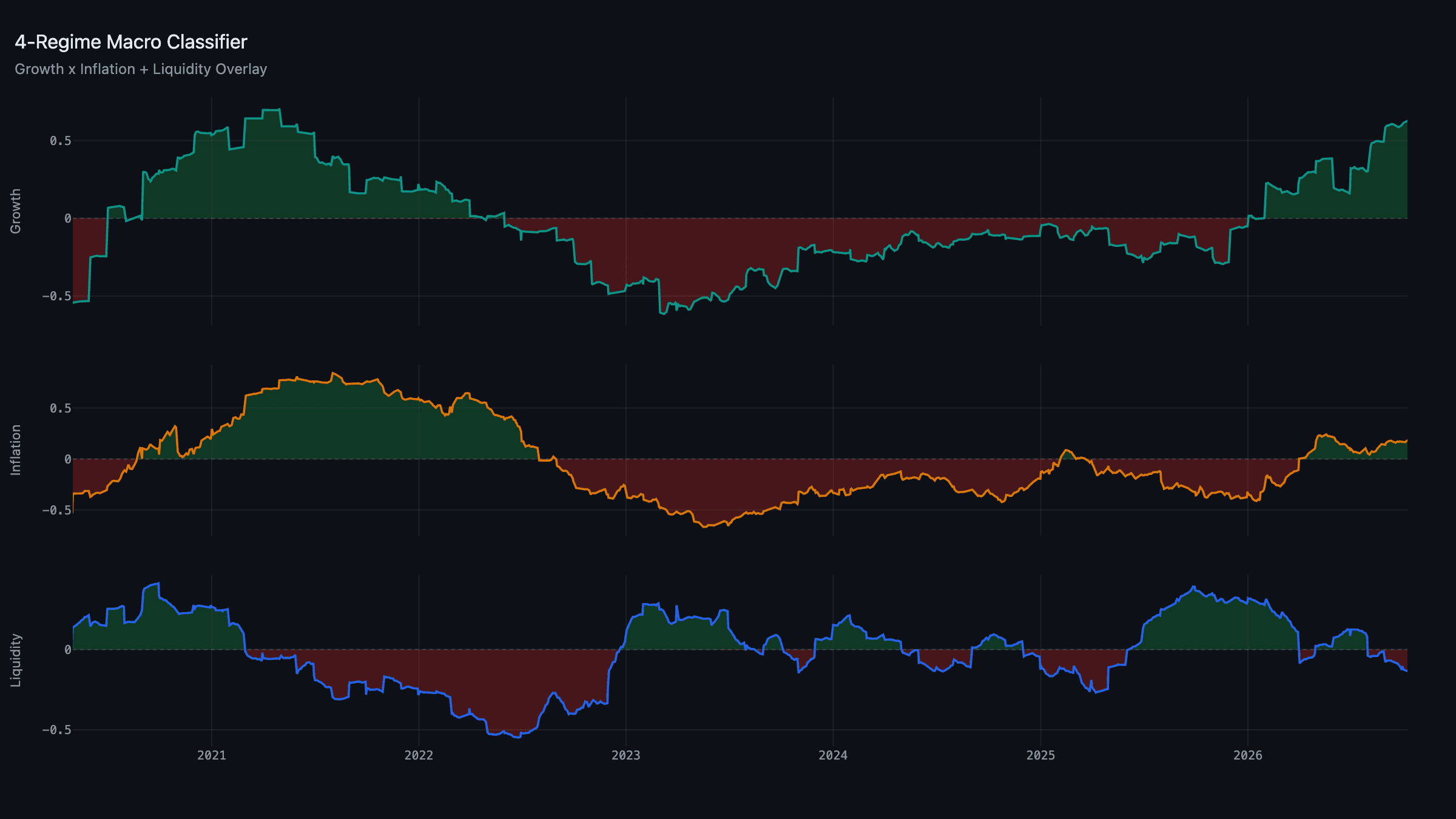
In short: Reflation / Contracting holds. Growth climbed to +0.63, inflation sits at +0.18 and liquidity at -0.14, with collateral & funding (P5) sliding further to -0.72. The October 1st tournament ran and rotated the book: SMH replaced EFA in the growth sleeve, and IEMG + CPER replaced BTC + HYG in the liquidity sleeve. Simulated backtest stats now stand at 20.2% CAGR / 1.50 Sharpe / 1.83 Calmar / -11.0% max drawdown. On the news side, one idea ties the week together: governments will borrow their way out. Japan is already doing it, the US will likely follow, and that is why we think real and growth assets are better placed than long-duration bonds. The 10-year is at its highest since 2002, but AI growth is outrunning it. And Trump importing Russian diesel is a small example of the same habit: short-term price relief bought at a long-term cost.
Composites: Growth Firms, Expectations Wake Up
Growth rose from +0.59 two weeks ago to +0.62 on October 2nd and +0.63 on Friday, another fresh high for this cycle. Input acquisition (P3) is still pinned near +0.98 and distribution (P5) holds at +0.29. The notable change is financial conditions (P1), which turned back up from -0.08 to +0.08 over the week. That is the pillar we flagged as leaking since the hike, so seeing it stabilize while yields climb is a good sign that the growth engine is not choking on rates yet.
Inflation edged up from +0.17 to +0.18. Pipeline costs (C2) are flat around +0.26, so cooling oil has stopped adding pressure without yet taking much away. The channel to watch is expectations (C4), which has gone from +0.01 two weeks ago to +0.06 and now +0.12. That is a small number, but the direction matters. It fits the story the bond market is telling: a 10-year at its highest since 2002 is investors asking to be paid more for holding government debt, and part of that is the fear that the debt will be inflated away.
Liquidity slipped from -0.13 to -0.14, still shallow Contracting. Underneath, the picture is mixed. Central bank liquidity (P1) improved from -0.20 to -0.09 and cross-border (P3) turned positive at +0.08. But collateral & funding (P5) kept falling, from -0.67 to -0.72, its weakest read in this stretch. Funding markets remain the clearest stress point in the model, and rising long rates do not help.
The regime reads Reflation / Contracting: strong growth, inflation that is positive and starting to show up in expectations, and liquidity that keeps tightening at the margin.
The Portfolio: October Rebalance Brings in Semiconductors
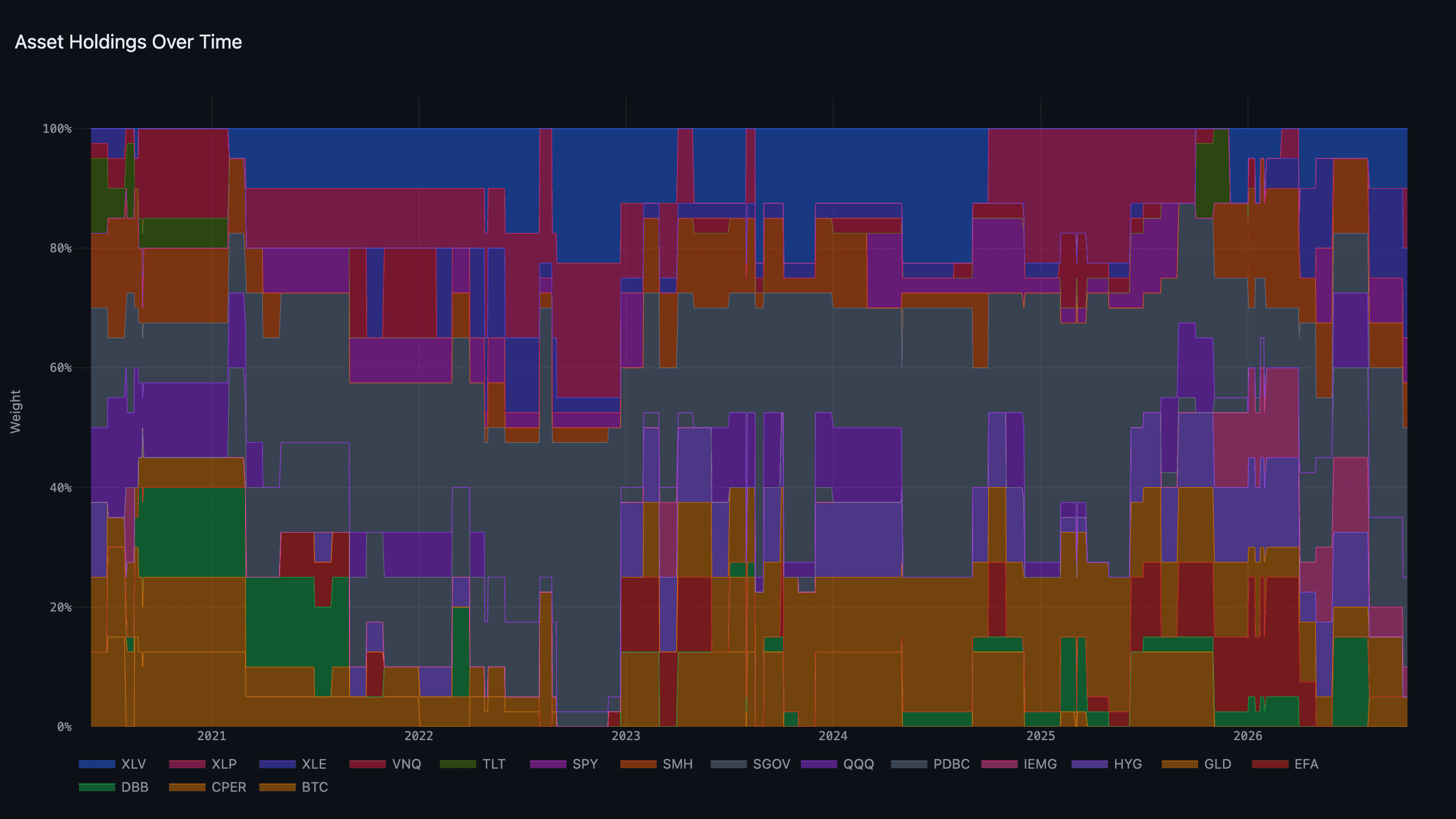
The October 1st tournament ran in the same regime, so the sleeve weights are unchanged, but two sleeves picked new winners:
- Cash: SGOV, 25%.
- Real assets: PDBC + XLE, 15% each.
- Defensive: XLV + XLP, 10% each.
- Growth: SMH + SPY, 7.5% each. (SMH replaces EFA.)
- Liquidity: IEMG + CPER, 5% each. (Replace BTC + HYG.)
Two things stand out. First, SMH coming into the growth sleeve is the model independently agreeing with our AI view: semiconductors have the strongest momentum in the pool, and that is where the AI buildout shows up first. Second, BTC dropped out of the book even though we argue below that it belongs in a debasement world. That is not a contradiction. The tournament picks on recent trend, and BTC has lost its momentum lead for now. Our editorial view runs on a horizon of years, the model runs month to month, and the model portfolio follows the model.
Simulated backtest stats are 20.2% CAGR, 1.50 Sharpe, 1.83 Calmar, and a -11.0% max drawdown, against 15.2% CAGR and a -25.4% drawdown for buy-and-hold S&P 500.
Japan Shows Where the World Is Headed
Japan has slow growth and about $9 trillion in public debt, the most of any advanced economy relative to its size. It also tends to hit these problems before everyone else, which makes it worth watching as a preview.
Its latest response is to cut consumption taxes and send payouts to households, with no clear plan to pay for either. The answer, in practice, will be more debt.
We think the US will run the same play. Borrow to fuel the AI boom, let inflation and debasement quietly shrink the real value of the debt, and hope growth eventually outruns it. As we wrote last month, growing out of the debt is the stated plan. What Japan adds is the honest version of how that plan gets financed in the meantime: more borrowing, and a currency that buys less over time.
Rates Are Up, But AI Growth Outruns Them
The 10-year Treasury yield is at its highest since 2002. That hurts everyone who borrows, from homebuyers to small businesses to the government itself.
But big tech is growing fast enough not to care. AI growth is currently outpacing oil, inflation and rates. The companies at the center of the buildout are expanding earnings faster than higher borrowing costs can eat into them.
The rest of the market is a different story. Roughly 40% of the S&P 500 is down since March. That is the deadweight in today's economy: rate-sensitive, slow-growing businesses that the higher cost of capital is grinding down. The growth is concentrated in the Nasdaq.
Concentration is a real risk, and tech will have bad years. But over a 10 to 15 year horizon, we still think tech wins. That is where productivity gains are coming from, and productivity is the only way out of the debt that does not involve inflation.
Russian Diesel: More Risk Than Reward
Trump is moving to import Russian diesel. The motive is easy to understand: lower energy prices before the midterms.
But it adds fuel to the geopolitical fire for an amount of diesel that may prove insignificant. Easing pressure on Russia sends a mixed signal to allies at a moment when the Gulf is only just calming down, and it hands Moscow a win for little measurable relief at the pump.
It is also a neat example of this week's theme. Politicians reach for short-term price relief and leave the long-term cost for later. Japan does it with tax cuts and payouts, Washington does it with borrowing, and now with diesel.
Our View: Real and Growth Assets Over Duration
This section is the author's opinion. It is not model output and not a recommendation to buy or sell anything.
In our view, in a world of debt and debasement, the assets best placed are the ones governments cannot print more of, plus the businesses growing fast enough to outrun the cost of capital:
- Gold: the oldest hedge against currency debasement.
- Bitcoin: the newer one, with a fixed supply. (Out of the model book for now, see above, but still part of our long-run view.)
- Growth and tech stocks: the part of the market where earnings are outrunning rates.
Bonds keep getting wrecked. If the plan is to inflate the debt away, long-duration government bonds are the asset being inflated away. A 10-year at its highest in over two decades is the market slowly pricing that in.
Week Ahead
- CPI (Wednesday October 14th): The big one. A hot print would add to the pressure on long yields and on expectations (C4), which is already climbing.
- PPI (Thursday October 15th): A read on whether pipeline costs (C2) are finally rolling over with cooler oil.
- Fed Beige Book (Tuesday October 13th): Anecdotal color on whether higher rates are starting to bite outside of tech.
- The 10-year: Whether yields keep climbing from their 2002 highs, and whether financial conditions (P1) hold up if they do.
- Collateral & funding (P5): Now at -0.72 and still falling. The clearest stress point in the model.
All model scores are normalized to a [-1, +1] scale through our proprietary normalization methodology. Positive readings indicate above-trend expansion. Negative readings indicate below-trend contraction. Data updated through October 9, 2026.
MacroScope models are systematic tools, not investment advice. Past performance does not guarantee future results.