MacroScope Weekly, September 27, 2026
Current Regime: Reflation / Contracting Liquidity
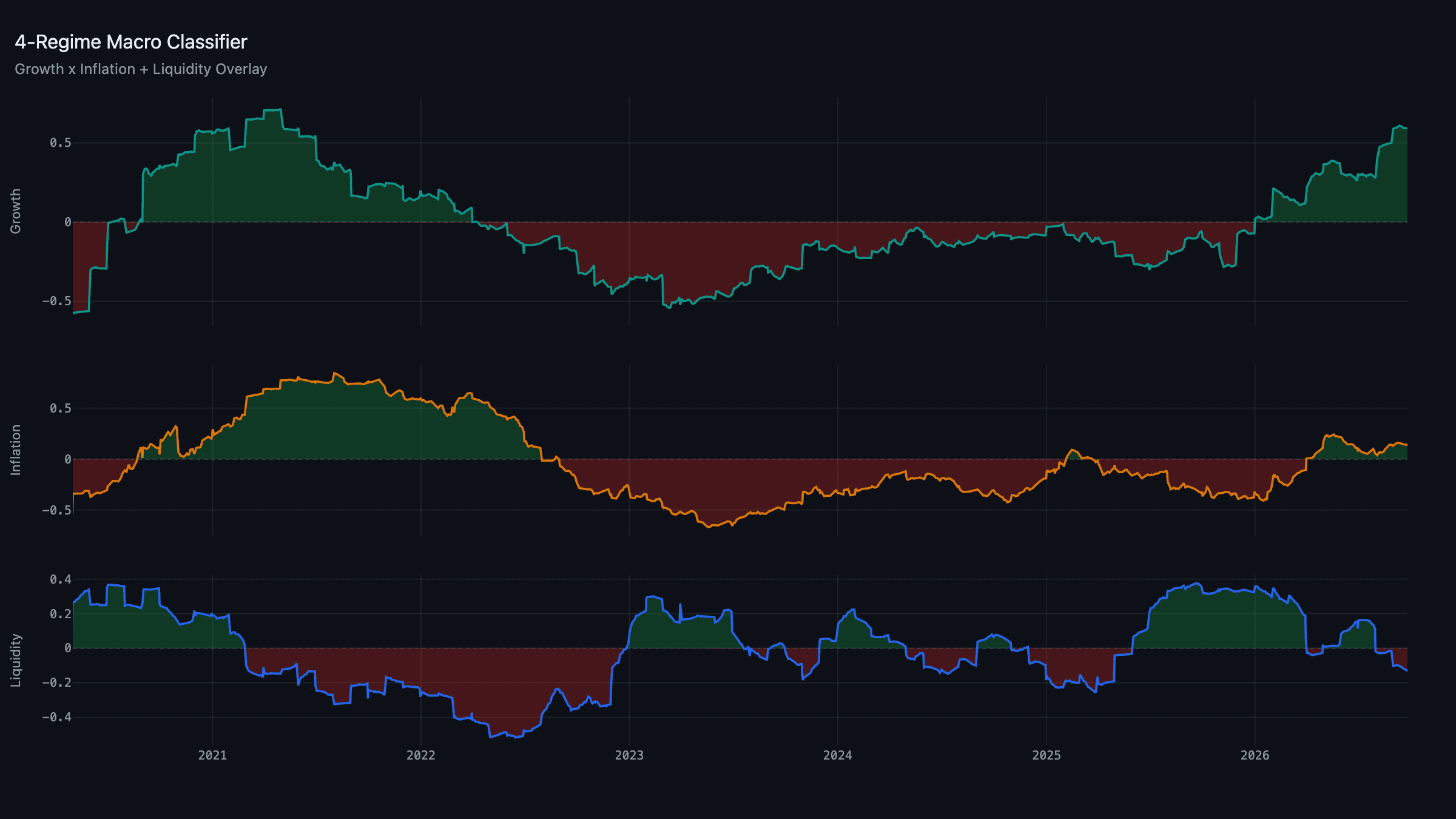
In short: Reflation / Contracting holds for another week. Growth sits at +0.59, inflation at +0.14 and liquidity at -0.13, with collateral & funding (P5) sliding again to -0.68, its fifth straight weekly decline. The inflation number looks like a big drop from last week, but most of it is a revision to the back data rather than a move within the week. No rebalance yet, the next tournament run is Thursday October 1st. Simulated backtest stats stand at 17.6% CAGR / 1.32 Sharpe / 1.55 Calmar / -11.4% max drawdown. On the news side it has been a quiet week, and the one headline worth your time is a good one: oil is cooling after topping out around $105, on reports that Iran could keep the Strait of Hormuz open to traffic. We think Trump has strong reasons to push for that, and we also think the China tech race means the US cannot afford to take its eye off the ball.
Composites: Steady Readings, One Pillar Still Sliding
Growth held at +0.59 all week, one of its strongest reads in this cycle. After this week's data revisions the Friday September 18th print now also reads +0.59, up from the +0.53 we quoted last week. Input acquisition (P3) pushed to a fresh high near +0.98, while distribution (P5) sat unchanged at +0.32. Financial conditions (P1) keeps drifting lower, from +0.26 two weeks ago to +0.13 now. It is the one growth pillar that has been leaking since the hike, and it is worth keeping an eye on.
Inflation reads +0.14. That is well below the +0.31 we reported last week, but the revised series puts the September 18th value at +0.14 too, so the week itself was flat. Pipeline costs (C2) ticked up from +0.22 to +0.25 through the week. That can look odd next to cooling oil, but this channel lags the spot price, so the relief would show up here over the coming weeks rather than immediately. Expectations (C4) stayed right around zero at +0.01.
Liquidity slipped from -0.10 to -0.13, still in shallow Contracting territory. The driver is the same as last week: collateral & funding (P5) fell from -0.60 to -0.68, its weakest read in this stretch and a fifth straight weekly decline. Central bank liquidity (P1) held at -0.24 and cross-border (P3) at -0.13, while private credit (P2) at +0.29 keeps doing most of the work on the positive side.
The regime reads Reflation / Contracting: strong growth, inflation that is positive but calmer than the summer, and liquidity that keeps tightening at the margin.
The Portfolio: One Week to the Rebalance
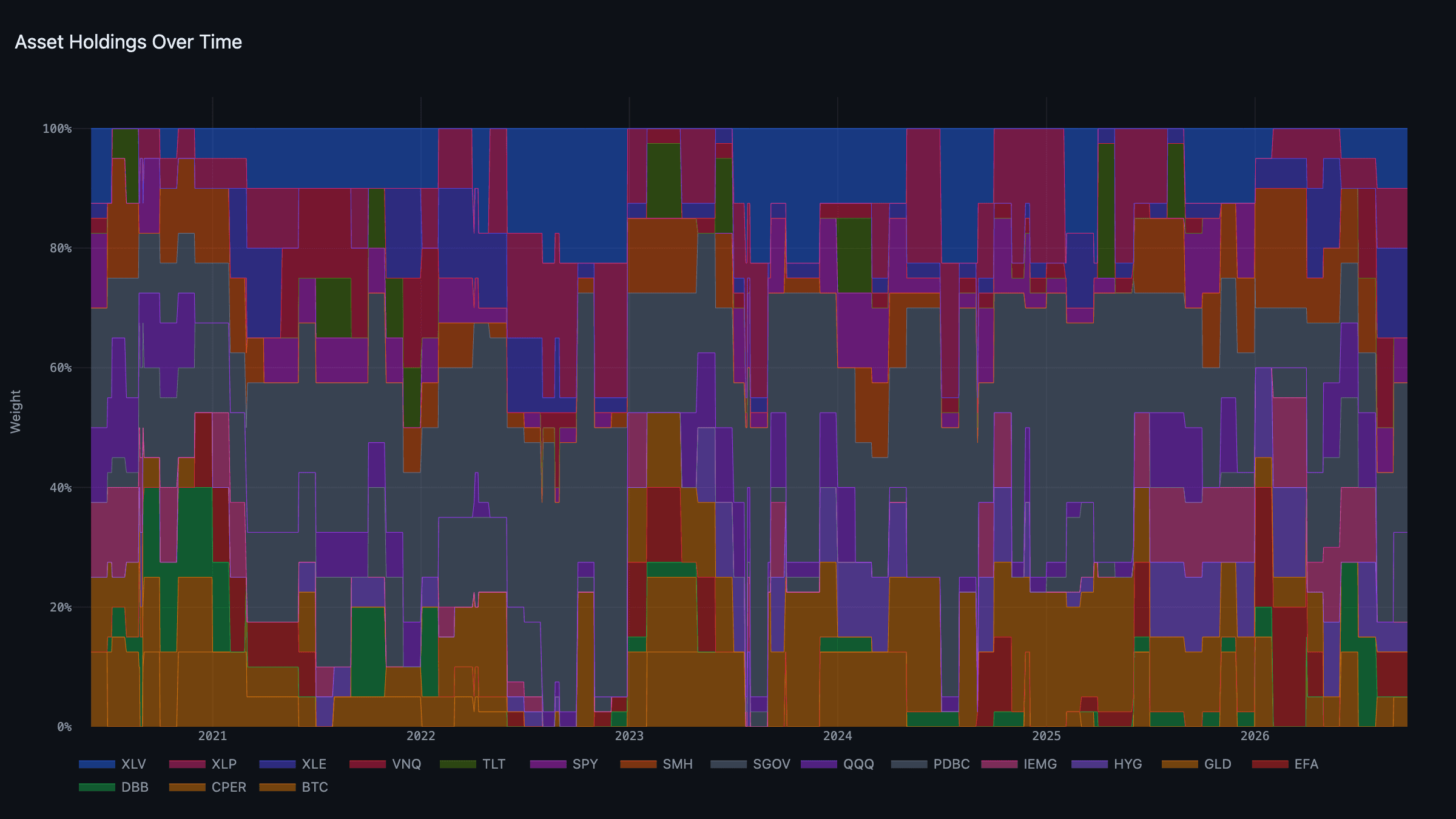
The book carries its September 1st weights into the final week before the October 1st tournament run:
- Cash: SGOV, 25%.
- Real assets: XLE + PDBC, 15% each.
- Defensive: XLV + XLP, 10% each.
- Growth: EFA + SPY, 7.5% each.
- Liquidity: BTC + HYG, 5% each.
Simulated backtest stats are 17.6% CAGR, 1.32 Sharpe, 1.55 Calmar, and a -11.4% max drawdown, against 15.1% CAGR and a -25.4% drawdown for buy-and-hold S&P 500. The max drawdown moved out from -10.2% to -11.4% this week, so the book gave some ground, but it is still less than half the index's worst drop. With oil cooling, the real assets sleeve is the one to watch on Thursday.
News: A Calm Week, and Oil Cools
Honestly, there has not been much to comment on this week. After a month of hikes, buybacks and war headlines, the news flow has gone quiet. The one development that does matter is a welcome one.
Oil cooling after topping out around $105 is a great sign for markets, and a hint that things may be cooling off with the war. The move comes alongside reports that Iran could keep the Strait of Hormuz open to traffic. Two weeks ago we flagged a reported Iran and Oman deal over the strait as a way for Iran to tighten its grip on the chokepoint. Keeping it open points the other way. It is still reports rather than anything signed, but the price action suggests the market is starting to believe it.
We think this may come as Trump realizes the Fed will not hold or cut rates as long as the war is ongoing. Warsh already hiked once and the dot plot still shows more. As long as oil is pushing on inflation, the Fed has cover to stay tight, and that is exactly what Trump does not want. The quickest way to take that cover away is to bring oil down, and the quickest way to bring oil down is to get the situation in the Gulf under control. So we would not be surprised to see him making extended efforts on that front.
It is in his best interest to keep the economy going. As we wrote last week, the plan to deal with US debt is to grow out of it, and the AI bet is at the center of that growth story. That bet needs cheap capital and a steady economy to pay off. A war that keeps oil high and the Fed hawkish works directly against it.
China is not willing to back down, and neither can the US afford to let them get ahead. Technology is one of the few bright spots in an otherwise quite dull Chinese economy, which means Beijing has every reason to keep pushing there. For the US, falling behind on AI would not just be a lost race, it would undercut the very growth bet that is supposed to relieve the debt. That makes the tech race a second reason Washington wants the Middle East settled: resources and attention spent on the Gulf are resources and attention not spent on competing with China.
Put together, the incentives all point toward de-escalation, and that is the most constructive setup we have had in weeks. The caveat is that incentives are not outcomes. If the Hormuz reports fall apart, oil can turn back up just as quickly.
Week Ahead
- October 1st rebalance: The tournament runs Thursday. Watch whether cooling oil costs XLE or PDBC their place in the real assets sleeve.
- Oil and Hormuz: Whether the reports of the strait staying open firm up into something concrete, or fade.
- Pipeline costs (C2): If oil stays down, this channel should start to roll over in the coming weeks.
- Collateral & funding (P5): Five weekly declines in a row, now at -0.68. Still the clearest stress point in the model.
- Fed speakers: Whether lower oil gives anyone on the committee room to soften the talk of further hikes.
All model scores are normalized to a [-1, +1] scale through our proprietary normalization methodology. Positive readings indicate above-trend expansion. Negative readings indicate below-trend contraction. Data updated through September 25, 2026.
MacroScope models are systematic tools, not investment advice. Past performance does not guarantee future results.