MacroScope Weekly, September 20, 2026
Current Regime: Reflation / Contracting Liquidity
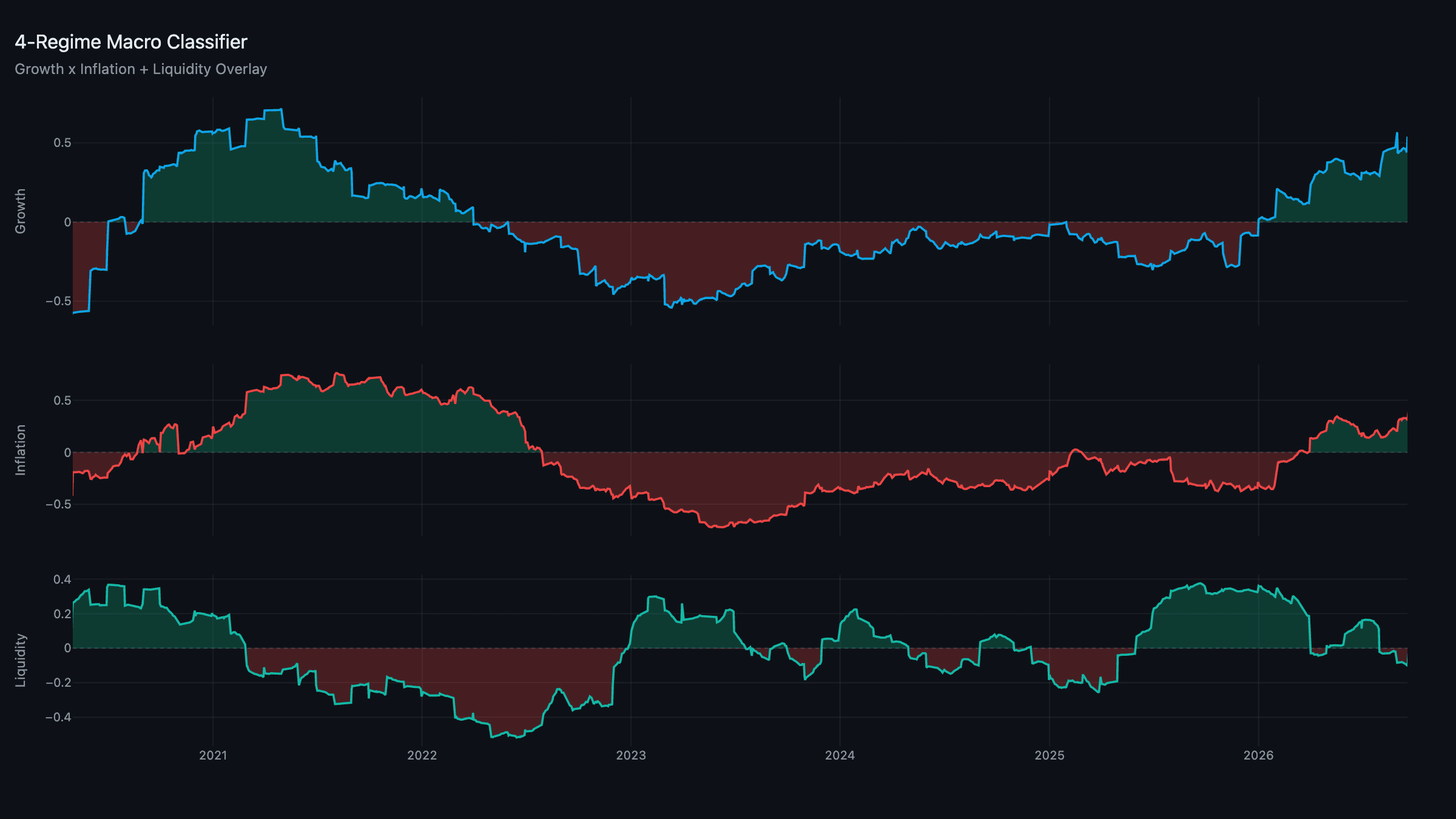
In short: Reflation / Contracting holds. Growth pushed up to +0.53 on Friday, inflation sits at +0.31, and liquidity remains in a shallow negative range at -0.10, with collateral & funding (P5) sinking to -0.60 through the week of the Fed decision. No rebalance: the book still carries its September 1st weights, with simulated backtest stats at 16.7% CAGR / 1.30 Sharpe / 1.64 Calmar / -10.2% max drawdown. On the news side: Warsh hiked 25bp, which we read as a credibility move after a shaky July rather than a data call, and we don't think the further hikes in the dot plot will actually arrive. The US has to grow its way out of its debt, which favors lower rates, and Trump seems locked into the AI boom plus lower rates as the solution, which makes us uneasy. The AI extinction warnings may be partly marketing, but dismissing them as a hoax is a mistake, and agentic crypto payments are up 500% in three months, which ties straight back to the guardrails question.
Composites: Growth Firms, Funding Stress Deepens
Growth pushed up to +0.53 on Friday from roughly +0.44 the day before, its strongest print of the week. Input acquisition (P3) stayed pinned near +0.95 and distribution (P5) held at +0.32, but financial conditions (P1) slipped from +0.26 a week ago to +0.16 by Thursday. That is the one growth pillar that reacted to the Fed's move, which is what you would expect from the pillar most sensitive to rates and credit.
Inflation held at +0.31, a touch below last week's +0.33. Pipeline costs (C2) firmed to +0.42, consistent with oil and diesel staying sticky on the Iran situation. Expectations (C4) is the one to watch: it slipped from roughly flat to -0.03 through the week, so the market is not treating the hike as a sign that inflation is about to run away.
Liquidity stayed at -0.10, in Contracting territory. The real story underneath is collateral & funding (P5), which fell steadily from -0.52 a week ago to -0.60, its weakest read in this stretch. Central bank liquidity (P1) held at -0.24 and cross-border (P3) at -0.13, offset by private credit (P2) at +0.30 and shadow banking (P4) at +0.11. A hiking Fed leaning on a funding market that was already stressed is not a comfortable combination, and the pillar is telling us so.
The regime reads Reflation / Contracting: strong growth, elevated inflation, and liquidity that is tightening at the margin rather than recovering.
The Portfolio: No Rebalance
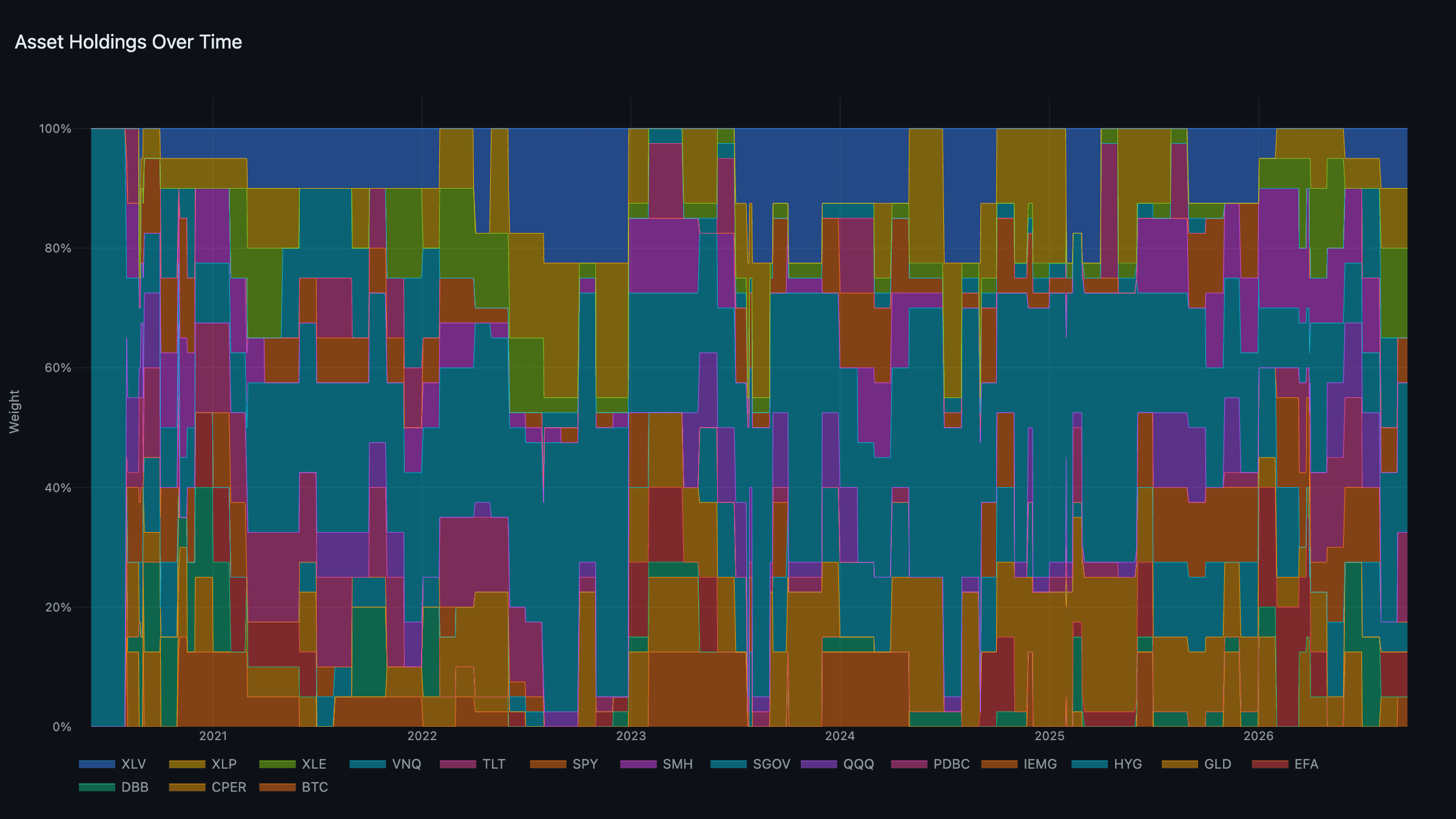
The book carries its September 1st weights unchanged, with the next tournament run scheduled for October 1st:
- Cash: SGOV, 25%.
- Real assets: XLE + PDBC, 15% each.
- Defensive: XLV + XLP, 10% each.
- Growth: EFA + SPY, 7.5% each.
- Liquidity: BTC + HYG, 5% each.
Simulated backtest stats are 16.7% CAGR, 1.30 Sharpe, 1.64 Calmar, and a -10.2% max drawdown, against 15.0% CAGR and a -25.4% drawdown for buy-and-hold S&P 500. The defensive Contracting weights did their job through a hike week. Nothing structural changes until October 1st.
The Fed: Hold or Hike?
Going in: the devil's advocate case for a hold.
Consensus was trading the data: sticky inflation from the Iran situation, a hawkish Jackson Hole, and a Fed whose credibility was on the line. The hike case writes itself.
But read it like Harvey Specter: play the man, not the hand. Warsh didn't get the seat by being a hawk. Trump appointed him expecting cuts, and that relationship still matters. The tell is US debt. With trillions rolling over in the coming years, a hike crosses the man who appointed him and makes refinancing more expensive.
We were not calling one outcome more likely, only that a hold was still very much in play.
What actually happened: Warsh hiked 25bp.
We got the outcome wrong on the devil's advocate side, but the reasoning about who Warsh is still helps explain why he hiked. Our read is that this was a credibility move after a shaky July, not a data call. A new chair who is seen as Trump's pick has to show the market he is not a rubber stamp, and a 25bp hike is the cheapest way to buy that. It is a statement about the chair, not about the inflation print.
The dot plot showing more hikes is the same play: setting expectations, not a real commitment. Guidance that promises further tightening does the credibility work without a single additional basis point being delivered.
Our call: those further hikes won't come. The same debt arithmetic that made a hold plausible going in still applies, and having established his credentials, Warsh has room to stop. Watch the funding markets: P5 is already at -0.60, and if it keeps deteriorating the pressure on the Fed points toward standing pat, not toward another move.
Trump, Debt, and the Growth Bet
The US has to grow its way out of the debt, and that favors lower rates, even though it is a risky bet.
The alternative is printing money to pay it down. That is the inflation that actually hurts, and it is a very different animal from the oil-driven kind the Fed is fighting now. A supply shock from Iran fades when the shock fades. Debt monetization does not.
Trump seems locked in on the AI boom plus lower rates solving the debt. It comes off a bit desperate: one bet on a technology that has not yet proven it can deliver that growth, and a second on a central bank that just hiked. He seems fine rolling the dice on AI risk as long as it fixes the debt, and that approach makes us uneasy.
AI Risk: Hype or Real?
Here is the counterpoint worth taking seriously: could the extinction warnings be partly marketing? Telling the world your AI is so powerful it could end humanity, as Anthropic and others have done, generates hype, and hype raises money.
But dismissing the risk as a hoax when it is raised by the people building it is like ignoring your surgeon because you don't like the x-ray. Having an incentive to say something does not make it false.
AI won't definitely wipe us out. But it needs guardrails, especially against misuse by bad actors.
Quick Hit: Agentic Payments
Agentic crypto payments rose 500% in the last three months, according to Elliptic.
That means AI agents making payments without human approval, like a smart speaker ordering bananas because it overheard you ran out.
It ties straight back to the section above: autonomy is arriving faster than guardrails.
Week Ahead
- Collateral & funding (P5): At -0.60 and falling. The clearest read on whether the hike is squeezing funding markets and whether that builds the case against further tightening.
- Fed speakers: Whether anyone on the committee treats the dot plot's further hikes as a real commitment, or walks them back.
- Expectations (C4): Now slightly negative. A move back up would say the market is doubting the credibility trade.
- Iran and oil: Pipeline costs are firming, so any escalation feeds directly into the inflation channel.
- October 1st: The next tournament rebalance, less than two weeks away.
All model scores are normalized to a [-1, +1] scale through our proprietary normalization methodology. Positive readings indicate above-trend expansion. Negative readings indicate below-trend contraction. Data updated through September 18, 2026.
MacroScope models are systematic tools, not investment advice. Past performance does not guarantee future results.