MacroScope Weekly, September 13, 2026
Current Regime: Reflation / Contracting Liquidity
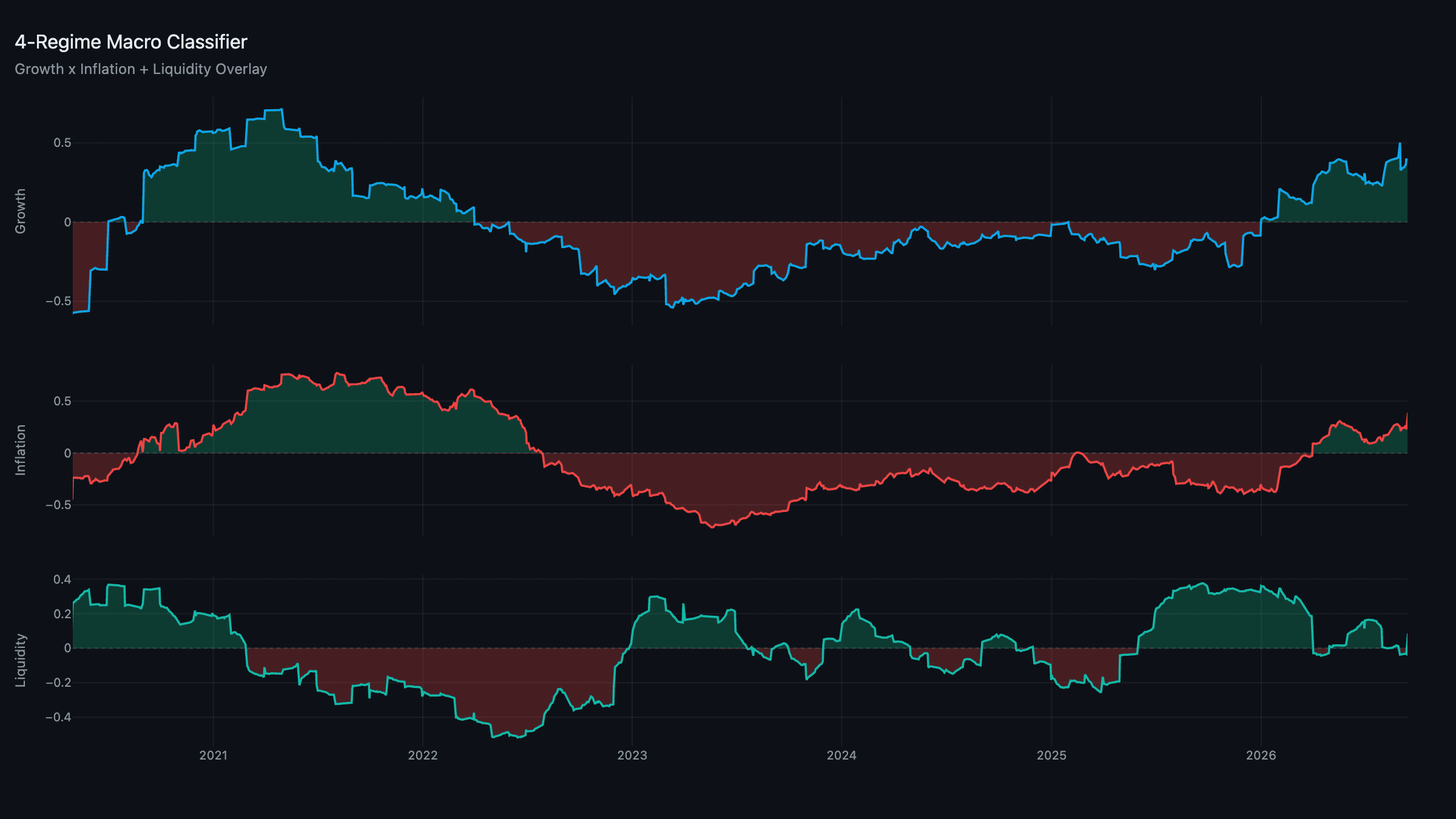
In short: Reflation / Contracting holds. Growth extended its climb to +0.39, up from +0.33 a week and a half ago, with the standout move coming from distribution (P5) flipping to +0.11, its first positive read after roughly a month stuck in the -0.30 to -0.40 range. Inflation eased to +0.23 after touching +0.26 mid-week, and liquidity stayed pinned in a shallow negative range around -0.03, essentially flat for the second straight week. No rebalance this week. The book carries its September 1st weights, and simulated backtest stats actually improved to 17.6% CAGR / 1.37 Sharpe / 1.72 Calmar / -10.2% max drawdown. On the news side: the US-Iran war shows no end in sight, and with no clean off-ramp for either side, we think further US escalation is more likely than a negotiated exit given the asymmetry in resources and a president unlikely to accept anything read as weakness. An unconfirmed but plausible report has Iran striking a deal with Oman over the Strait of Hormuz, which would tighten Iranian leverage over a critical chokepoint. Japan's Treasury holdings fell last month anyway, despite US efforts to keep Tokyo holding the line, as large yen-defense interventions forced sales. Bessent's "I'm the house" bravado reads as real market-power signaling, but with yields still climbing despite tripled buybacks, the swagger isn't landing the way it's meant to, and Trump floating a $5,000 stimulus check tied to the midterms adds another data point to a bigger-picture erosion of policymaker credibility that we think matters more for yields than the war itself.
Composites: Distribution Finally Turns, Liquidity Stays Pinned
Growth climbed to +0.39, extending a steady grind higher from +0.33 at the start of the month. The real story here is distribution (P5), which flipped to +0.11 after being the composite's stubborn laggard for the better part of a month in the -0.30 to -0.40 range, a genuine turnaround rather than a one-day blip, since it's held there for the past week. Input acquisition (P3) pushed to a fresh high near +0.96, financial conditions (P1) kept improving to +0.27, and decision (P2) and production (P4) both stayed strong in the high 0.7s-0.9s. This is one of the more broadly constructive growth prints we've seen in weeks, with every pillar contributing rather than one outlier carrying the composite.
Inflation eased to +0.23 after peaking near +0.26 mid-week. Pipeline costs held around +0.39, still elevated and consistent with oil and diesel staying sticky on the ongoing Iran situation, while expectations (C4) and services inflation (C6) both moved less negative than they've been in weeks, a mild warming that's worth watching even though the composite as a whole cooled slightly. Liquidity stayed essentially flat at -0.03, holding in a shallow Contracting band for a second straight week rather than either recovering or deteriorating further. Collateral & funding (P5) is the pillar we're watching most closely here: it held at -0.51, unchanged from two weeks ago despite the Treasury's reported buyback increase. If the buyback were genuinely easing funding-market stress the way it did briefly in August, we'd expect to see this pillar moving, and right now it isn't. The regime holds at Reflation / Contracting, strong and broadening growth, inflation still elevated but off its peak, and liquidity stuck rather than trending either direction.
The Portfolio: Holding Steady, Stats Improve
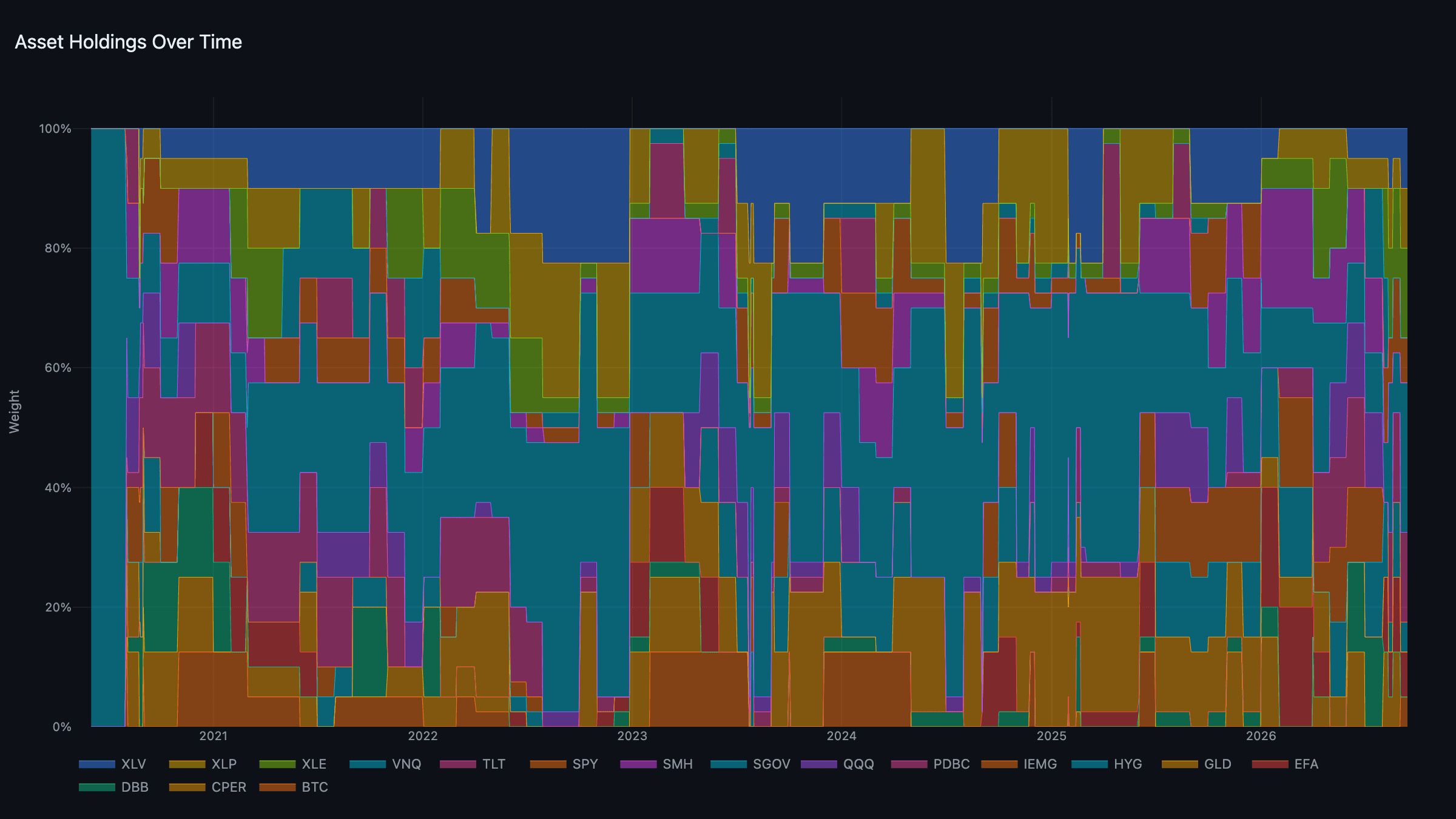
No rebalance this week. The book carries its September 1st weights unchanged, with the next tournament run scheduled for October 1st:
- Cash: SGOV, 25%.
- Real assets: XLE + PDBC, 15% each.
- Defensive: XLV + XLP, 10% each.
- Growth: EFA + SPY, 7.5% each.
- Liquidity: BTC + HYG, 5% each.
Simulated backtest stats actually improved this week to 17.6% CAGR, 1.37 Sharpe, 1.72 Calmar, and a -10.2% max drawdown, a genuinely better set of numbers than two weeks ago, consistent with growth's broad-based strength showing up in realized performance even with the book sitting in its more defensive Contracting-regime weights. Nothing structural changes here until October 1st.
News: No End in Sight, Japan Sells Anyway, and the House Doesn't Cover
The US-Iran war shows no sign of ending, and that lack of resolution is likely to keep short-term inflation stickier than currently expected. Raising the odds the Fed eventually needs to hike in response. Both sides appear to be betting they can outlast the other, but we don't see the US losing this war of attrition: it simply has too many resources at its disposal, and a president too stubborn to accept any outcome that reads as American weakness. That combination points toward further US escalation as the more likely path to forcing a resolution, rather than a negotiated de-escalation, which is not the direction that would actually help the inflation picture.
A reported deal between Iran and Oman over control of the Strait of Hormuz (unconfirmed so far, but a strong "if true") would be a real jab at the US, not a good sign for where this is heading. Iran effectively flexing strength by securing tighter control over what passes through one of the world's most important oil chokepoints would directly worsen the domestic inflation picture further, layering on top of an already-sticky pipeline-costs channel. We'd treat this as unconfirmed for now, but it's exactly the kind of headline risk worth pricing some probability into rather than dismissing outright.
Despite US efforts to keep Japan holding onto its Treasuries, Japan's holdings fell last month. They sold UST anyway to defend the yen amid large FX interventions. This may well have been something loosely agreed to at the recent US-Japan coordination meeting we flagged last week, but it's not the outcome Washington actually wants while it's already fighting to stabilize a bond market facing surging yields. A cooperative relationship on paper doesn't prevent Japan from doing what it needs to do domestically when the yen is under real pressure, and that's exactly the forced-seller dynamic the US has been trying to head off all year.
Bessent joking that he's "the house" and daring people to bet against him is fun on the surface, but underneath it's a real flex of market power, and it raises the question of what, exactly, he's that confident about. Is the confidence just backing the market's existing consensus around a 25bp hike, or is he hinting at something more aggressive, like a surprise 50bp move? Our bet is on the more boring outcome (just 25bp) with Bessent riding high off what looked like a smooth Treasury intervention and simply taking the opportunity to speak more freely than the usual scripted Treasury lines allow. The funniest tail-risk scenario here: he baits the market into piling into USD/JPY shorts, no hike materializes, and those shorts get blown up on the reversal. Unlikely, but funny to imagine.
That bravado hasn't aged particularly well, though. The Treasury tripled its buybacks and yields still ripped higher anyway. Talking yields down only works if the market actually believes you're in control of the situation, and right now Bessent isn't convincing anyone of that. Our own composite backs this up directly: the collateral & funding pillar that briefly improved when the buyback was first announced has now sat flat for two straight weeks despite the reported increase in buyback size. If the mechanism were working as intended, we'd expect to see that pillar moving, not stalling.
Trump floating a $5,000 stimulus check to every American conditional on Republicans holding Congress isn't exactly the fiscal discipline signal bond investors want to see right now. Whatever the political logic behind it, a headline like this lands at a particularly unhelpful moment for a Treasury that's already struggling to convince the market it has yields under control.
None of this (the "house" bravado, the tripled buybacks, or the stimulus talk) is doing anything to rebuild trust in policymakers, and that erosion of trust is, in our view, a bigger problem for yields right now than the Iran war itself. The war explains a real, identifiable channel of inflation pressure through oil and diesel. But a market that no longer fully believes its own Treasury Secretary is a structural problem that doesn't resolve with a ceasefire. It resolves only when actions start matching the confidence being projected, and so far that hasn't happened.
Week Ahead
- Collateral & funding (P5): Stalled at -0.51 for two weeks despite the buyback increase. The clearest test of whether Bessent's confidence is backed by anything mechanical.
- The Fed decision: Whether it lands at the consensus 25bp or surprises with something larger, and how the market (and Bessent's credibility) responds either way.
- Iran-Oman Hormuz reports: Watching for confirmation or denial. A real deal here would be a meaningful escalation in the inflation risk, not just a headline.
- Japan's Treasury holdings: Whether last month's decline was a one-off tied to a specific intervention or the start of a more persistent pattern.
- Distribution's turnaround (P5): Whether growth's newly broad-based strength holds through another week or reverts back toward its month-long laggard status.
All model scores are normalized to a [-1, +1] scale through our proprietary normalization methodology. Positive readings indicate above-trend expansion. Negative readings indicate below-trend contraction. Data updated through September 11, 2026.
MacroScope models are systematic tools, not investment advice. Past performance does not guarantee future results.