MacroScope Weekly, September 6, 2026
Current Regime: Reflation / Contracting Liquidity
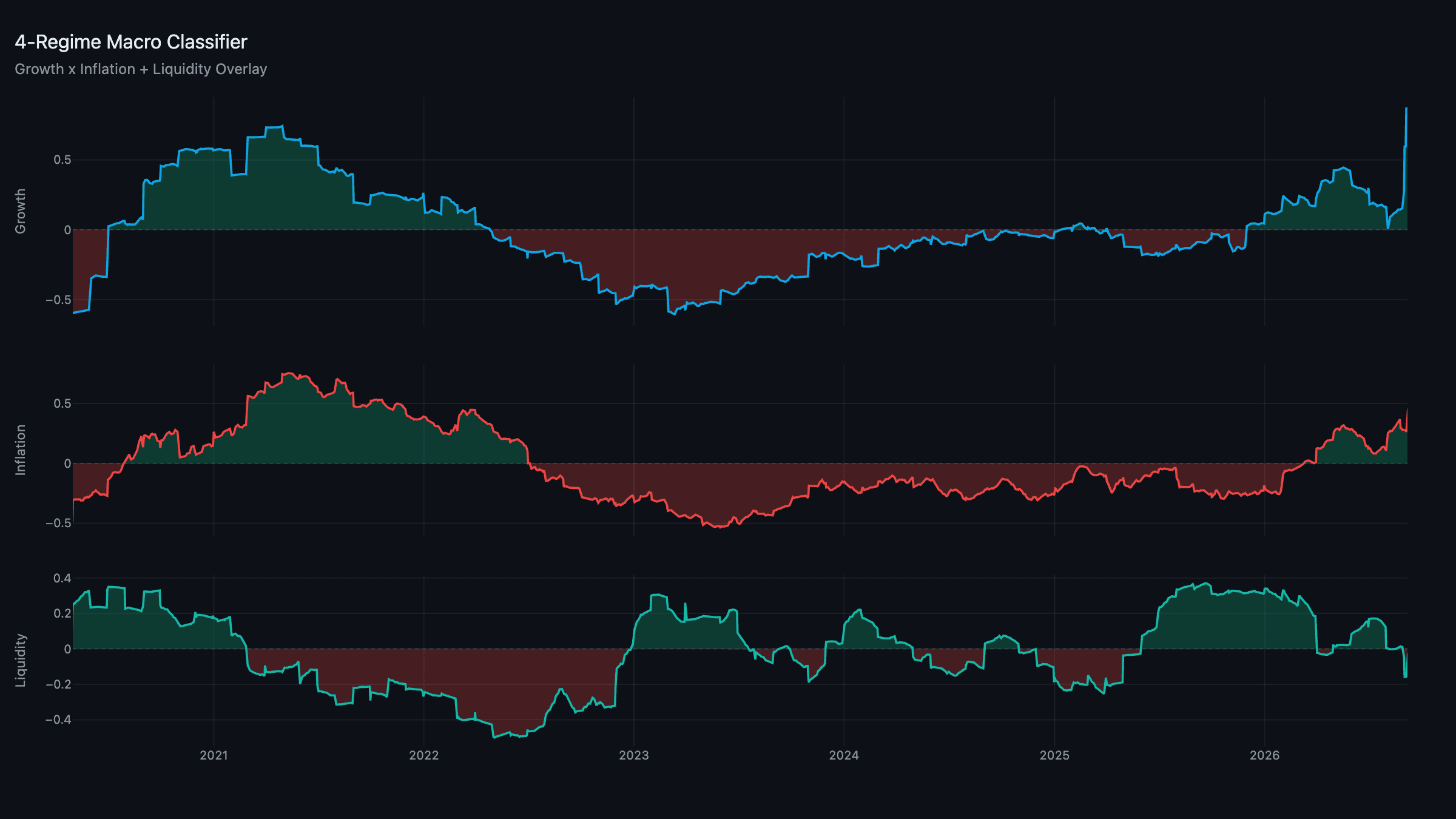
In short: The overlay flips back to Reflation / Contracting after just two weeks in Expanding. Liquidity reversed hard to -0.16, its sharpest print since early August. Growth spiked to +0.87, the strongest read we've seen this cycle, while inflation held roughly steady at +0.26. The September 1st tournament rebalance landed alongside the regime flip: cash jumped back to 25%, real assets and defensive both grew, and growth and liquidity sleeves were both cut. Simulated backtest stats hold at 16.9% CAGR / 1.29 Sharpe / 1.53 Calmar / -11.0% max drawdown. On the news side: yields keep climbing as further escalation (not de-escalation) in the US-Iran situation pushes oil and diesel higher and keeps inflation elevated, pushing the Fed toward more hawkish rhetoric and rising rate-hike odds, though we still think the base case is a hold unless the situation forces their hand. Bessent met with the Bank of Japan governor to keep macro policy coordinated, which matters enormously given Japan is the largest foreign holder of US Treasuries and a weak yen without US cooperation raises the odds of Japan selling UST to defend its currency, and Waller's notably dovish speech directly contradicted Warsh's hawkish tone from last week, though both are ultimately hostage to the next inflation print.
Composites: Growth Spikes to a Cycle High, Liquidity Reverses Hard
Growth spiked to +0.87, by far the strongest print in this letter series and a sharp break from the 0.15 range that held through most of late August. Input acquisition (P3) and production (P4) both remain firm in the high 0.8s-0.9s, and distribution (P5) (the composite's persistent laggard for the better part of a month) improved meaningfully off its lows. It's worth noting the composite is built from indicator-level z-scores rather than a simple average of the five pillar scores, so a move this size doesn't always trace cleanly back to one pillar. The honest read is that a broad swath of the underlying growth data turned up together at the same time, likely reflecting the same month-turn data refresh pattern we've flagged before rather than a single clean catalyst.
Inflation held roughly steady at +0.26, easing only slightly from the high-0.28 range that persisted through the back half of August. Pipeline costs (C2) actually firmed further to +0.45, consistent with oil and diesel staying elevated on the Iran situation (more below), while expectations (C4) improved modestly. Liquidity is the sharper story: it reversed from +0.01 two weeks ago to -0.16, crossing decisively back into Contracting after its brief two-week stint in Expanding territory. Central bank liquidity (P1) worsened to -0.22 and private credit (P2) eased back to +0.30 from the mid-0.4s, a real reversal, not just noise, and one that lines up with a Fed leaning more hawkish under pressure from the Iran-driven inflation story. The regime reads Reflation / Contracting, strong growth, sticky inflation, and liquidity tightening again, which is exactly the combination the framework's own weighting scheme treats most defensively.
The Portfolio: September 1st Rebalance Lands Defensive
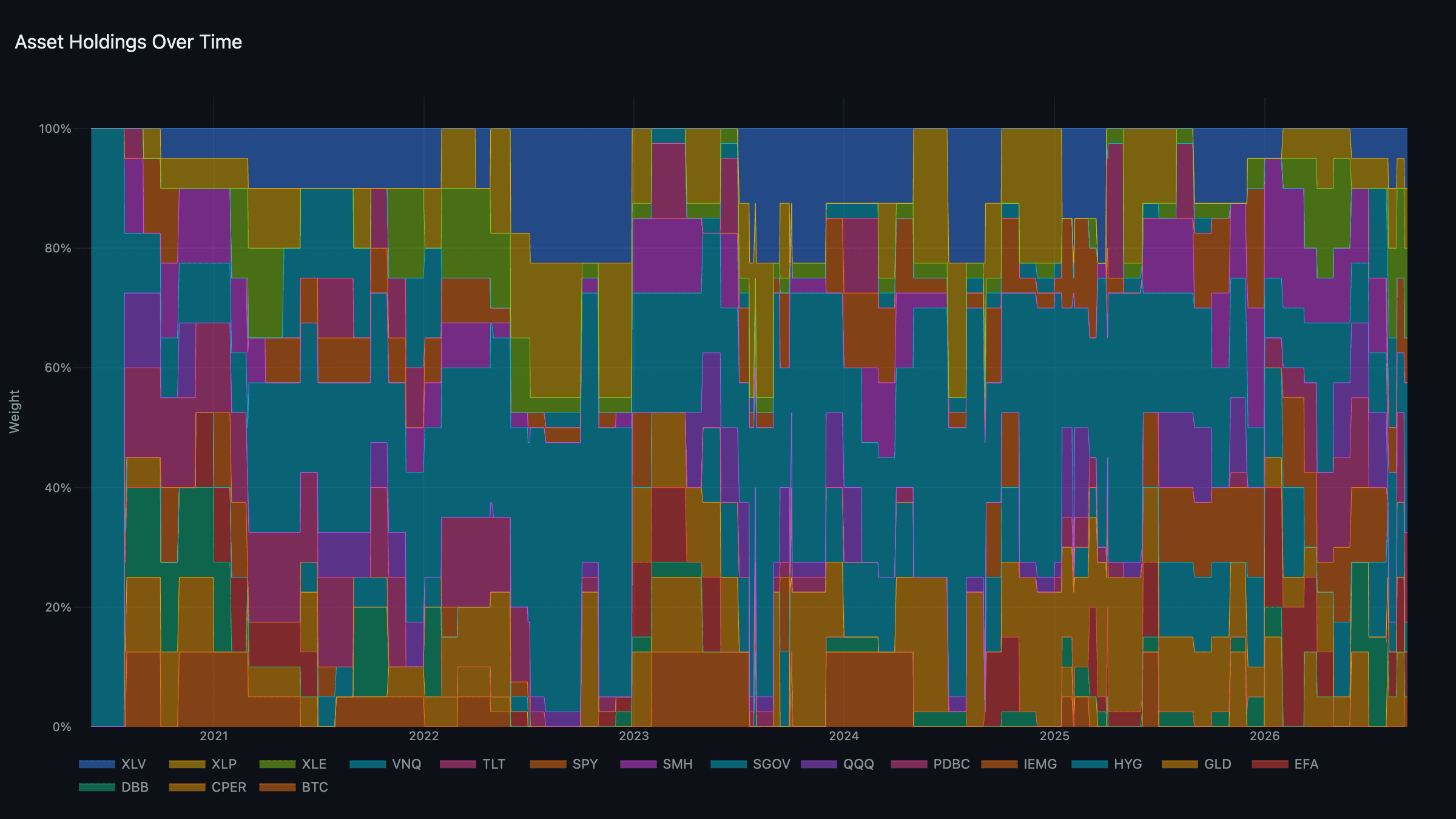
The tournament ran on schedule September 1st, and the regime flip back to Contracting pushed the book toward its more defensive base weights:
- Cash: SGOV, 25%, back up from 10%.
- Real assets: XLE + PDBC, 15% each.
- Defensive: XLV + XLP, 10% each, up from 5%.
- Growth: EFA + SPY, 7.5% each, cut from 12.5%.
- Liquidity: BTC + HYG, 5% each, cut from 12.5%.
The sleeve picks themselves are largely unchanged from what the book carried through August (real assets stays in XLE + PDBC, growth stays in EFA + SPY, and liquidity keeps its BTC + HYG pairing) but the percentages moved hard as soon as the regime confirmed Contracting, cutting the combined growth-and-liquidity weight from 50% back down to 12.5%. Simulated backtest stats hold at 16.9% CAGR, 1.29 Sharpe, 1.53 Calmar, and a -11.0% max drawdown, essentially unchanged from two weeks ago. The book has round-tripped through an Expanding stint and back without much net effect on trailing performance.
News: Iran Keeps Yields Climbing, Bessent Courts Japan, and the Fed Splits
Yields kept rising this week as the Fed turned more hawkish in response to further escalation (not de-escalation) in the US-Iran situation, which keeps pushing oil prices up and inflation elevated. The Fed is responding with more hawkish commentary, and odds of a rate hike are rising in step. The logic runs in a straight line: to actually get the situation under control, the US needs the Iran conflict to de-escalate, since oil and diesel prices remain the biggest short-term driver of the inflation print that's keeping the Fed on edge. Our view continues to be that the Fed's base case is still to hold, but if this conflict keeps escalating rather than cooling, they will eventually have no choice but to hike in order to restore credibility and keep inflation expectations anchored. That's a very different scenario from a hike chosen out of strength, and markets should treat it accordingly if it materializes.
In the middle of all this, the US also needs to keep Japan firmly on its side, and Scott Bessent's meeting with the Bank of Japan governor this week reads as exactly that kind of relationship management. This matters more than it might look at first glance: Japan is the largest foreign holder of US Treasuries, and with the yen still weak, one of the moves available to Tokyo (absent continued cooperation from Washington) is to sell UST outright to help strengthen its own currency. That's precisely the forced-seller scenario the US has been trying to avoid all year, which is why sustained coordination here isn't just diplomatic niceties, it's balance-sheet management with real stakes for the long end of the curve.
Fed Governor Waller's speech this week landed directly contrary to Warsh's hawkish comments from last week, which had priced in rate hike odds for September. Waller struck a notably more dovish tone, advocating for patience rather than preemptive tightening. But a lot of this still comes down to conditional language. It depends heavily on the next inflation print, and whether it proves stickier than currently expected given the oil and diesel pressure described above. Even so, the split between Warsh and Waller is itself informative: it shows the base case the Fed actually wants is to hold, or more likely eventually cut, not hike. It's worth remembering what sits over their heads through all of this. A massive debt load that needs refinancing, and the Fed would much rather see that happen under a favorable, lower-rate environment than fight a rearguard action against energy-driven inflation with higher rates.
Week Ahead
- Liquidity's Contracting reversal: Whether this settles into a new leg lower or proves as short-lived as the Expanding stint that preceded it.
- Growth's cycle-high print: Whether +0.87 holds or partially reverts once the month-turn data settles, given how sharply it moved.
- The next inflation print: The single biggest swing factor for whether Waller's dovish patience or Warsh's hawkish September pricing turns out to be right.
- Iran de-escalation (or lack of it): The key variable behind sticky diesel and oil prices, and by extension, how much room the Fed actually has to hold rather than hike.
- US-Japan coordination: Watching for any sign Bessent's outreach to the BOJ is enough to keep Japan away from selling UST outright to defend the yen.
All model scores are normalized to a [-1, +1] scale through our proprietary normalization methodology. Positive readings indicate above-trend expansion. Negative readings indicate below-trend contraction. Data updated through September 4, 2026.
MacroScope models are systematic tools, not investment advice. Past performance does not guarantee future results.