MacroScope Weekly, August 30, 2026
Current Regime: Reflation / Expanding Liquidity
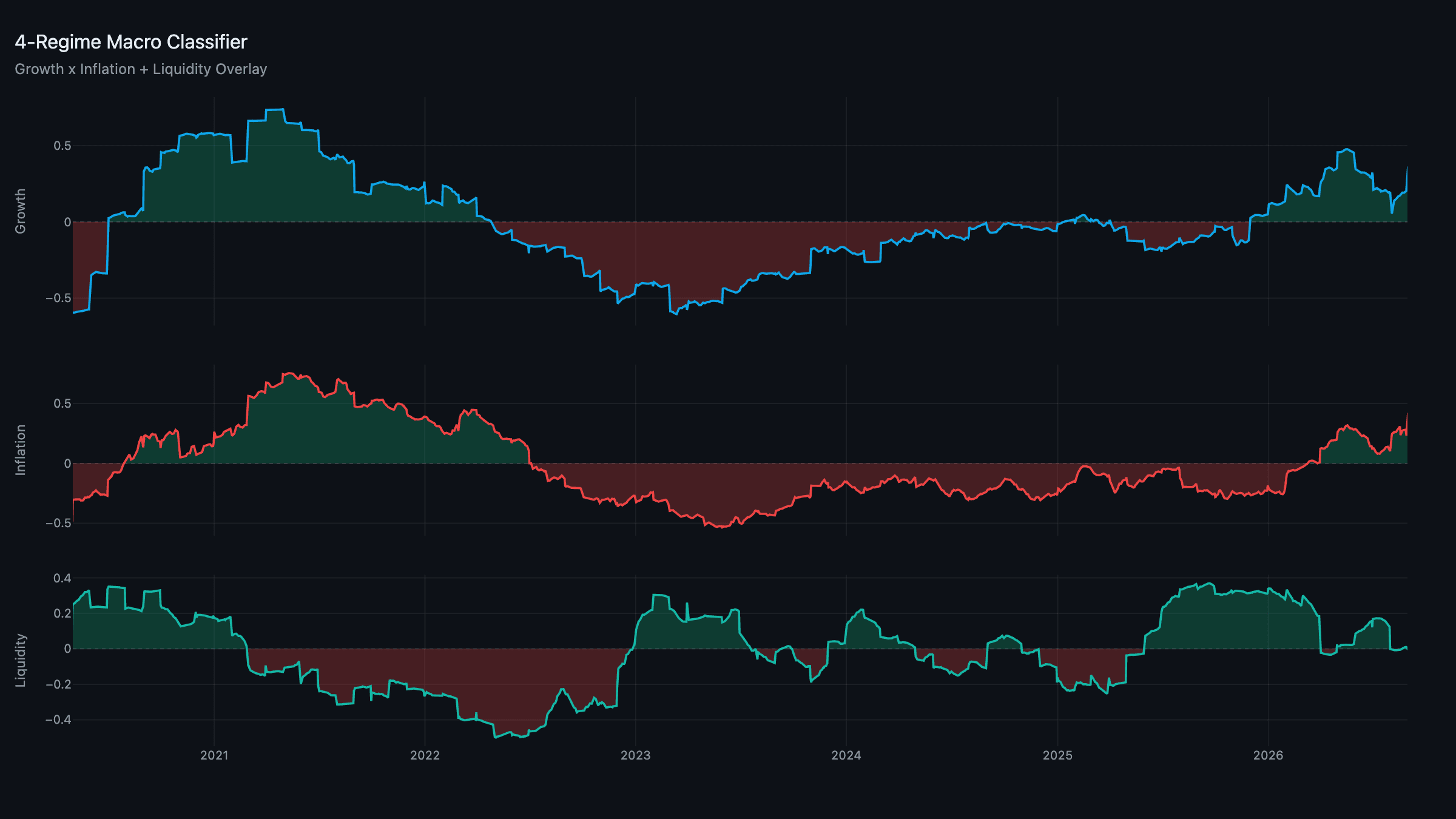
In short: Reflation / Expanding holds for a second week. Growth ticked up to +0.20, essentially flat versus last week's read, while inflation cooled to +0.23 after climbing as high as +0.28 mid-week, still elevated, and still leaning on sticky energy costs. Liquidity held at +0.01, comfortably positive for a second straight week, with collateral & funding (P5) continuing to improve to -0.53 from -0.56. A direct continuation of the trend we flagged last week following the Treasury's buyback announcement. The portfolio carries its Expanding-regime weights into the September 1st tournament run. Simulated backtest stats sit at roughly 16.8% CAGR / 1.28 Sharpe / 1.52 Calmar / -11.0% max drawdown, essentially unchanged week over week. On the news side: the US's own "economic warfare" campaign against Iran is dragging the conflict out longer than it otherwise might, keeping US diesel costs elevated and hitting agriculture particularly hard, which is exactly the oil/diesel constraint we flagged last week as standing in the way of further stimulus. CNBC reported Treasury officials are considering tapping the TGA to help fund the long-end buyback increase, a real (if unconfirmed) step toward the liquidity angle we said wasn't there yet, and NVIDIA's results came in strong with no letup in demand and rising forward revenue guidance, which could plausibly respawn risk-on sentiment across the AI trade.
Composites: Liquidity Holds, Inflation Cools Off Its Peak
Liquidity held at +0.01, confirming Expanding for a second straight week rather than reverting to the boundary the way it hovered for most of August. The driver we called out last week kept driving: collateral & funding (P5) improved again, to -0.53 from -0.56, its third consecutive weekly improvement since the Treasury's buyback announcement started easing term-premium and repo-market stress. Private credit (P2) also firmed, and the composite's other pillars held broadly steady. This is starting to look less like a one-week bounce and more like a genuine, if gradual, thaw in funding conditions.
Growth ticked up to +0.20, barely moved from last week's +0.20. Input acquisition (P3) stayed strong near 0.87 and production held firm, while distribution (P5) remains stuck at -0.30, unchanged for nearly a month now. Inflation is the more interesting mover: it ran as high as +0.28 in the middle of the week before cooling back to +0.23 by Friday. Still elevated relative to where it sat through most of August, and pipeline costs and demand pressure are the pillars keeping it there. That's consistent with the diesel and energy story below: until the underlying cost pressure actually breaks, inflation has a floor under it that the composite can't fully shake. The regime holds at Reflation / Expanding, growth positive, liquidity confirmed, and inflation elevated but not yet regime-breaking.
The Portfolio: Steady Into the September 1st Rebalance
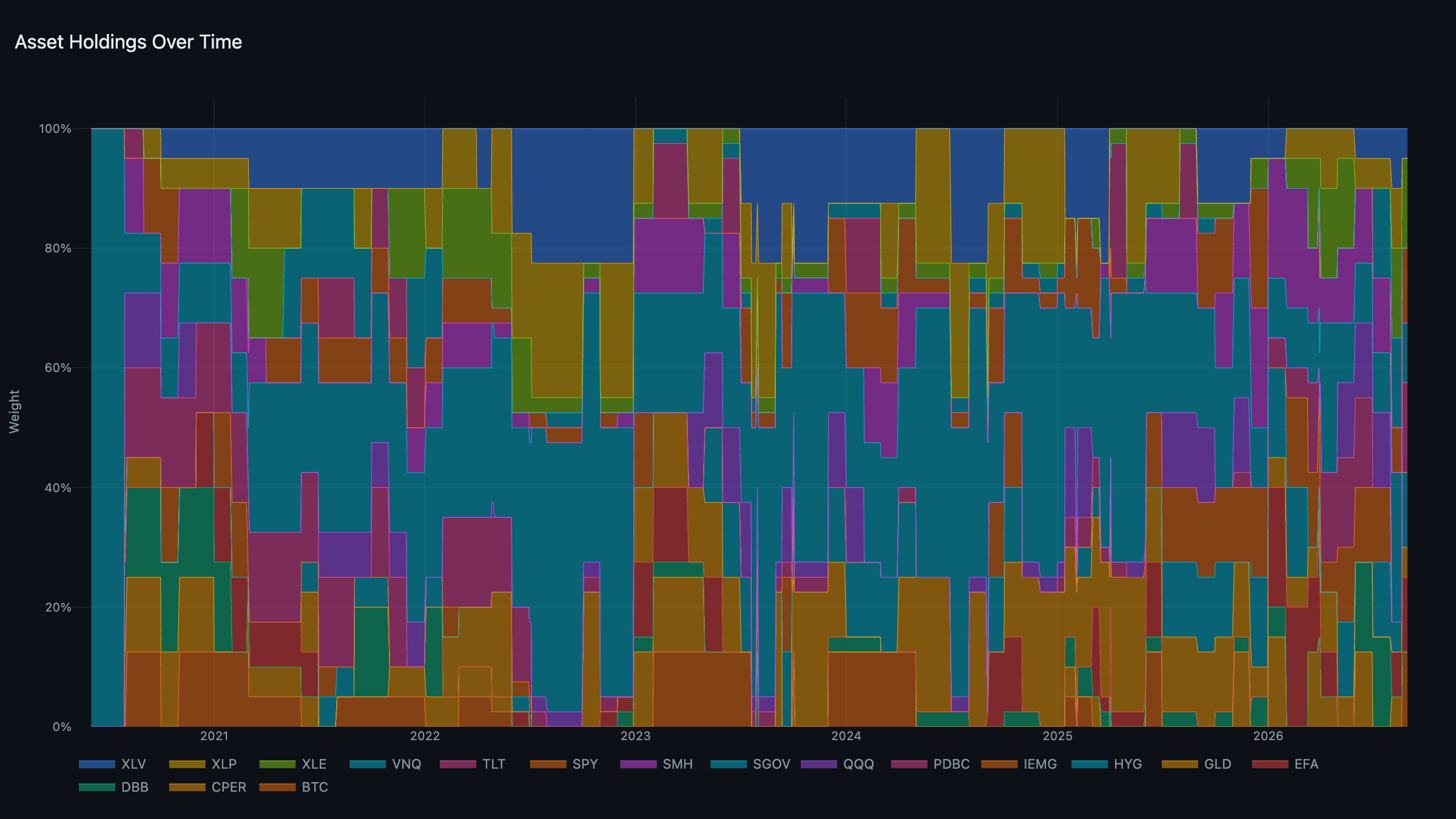
No scheduled rebalance this week. The book carries its regime-driven Expanding weights into next week's tournament run, with the sleeves currently allocated as:
- Real assets: XLE + PDBC, 15% each.
- Growth: SPY + EFA, 12.5% each.
- Liquidity: HYG + BTC, 12.5% each.
- Cash: SGOV, 10%.
- Defensive: XLV + GLD, 5% each.
Simulated backtest stats sit at roughly 16.8% CAGR, 1.28 Sharpe, 1.52 Calmar, and a -11.0% max drawdown, essentially flat week over week, consistent with a book that's been holding steady rather than chasing the elevated inflation print. The September 1st tournament run is next up, and it'll be the first real test of whether these sleeve pairings hold under a fresh momentum read.
News: The War's Own Cost, the TGA Gets Named, and NVIDIA Delivers
The US describing its posture toward Iran as "economic warfare" is accurate, but it's worth being honest that this kind of pressure campaign cuts both ways. Dragging the conflict out longer than it otherwise needs to run keeps US diesel costs elevated for longer than they otherwise would be, and that's a real economic cost being paid at home, not just abroad. Diesel remains one of the few inflation channels that won't meaningfully cool until the war and the broader oil situation are actually resolved, and it's a cost that lands on both companies and private individuals, not the kind of friction that favors the AI-driven growth boom the administration is counting on. Agriculture looks like one of the industries taking the hardest hit here, since diesel engines simply generate more usable power than gas engines for the heavy equipment that sector depends on, leaving farm operators with fewer substitution options than most other diesel-dependent industries.
This is exactly the constraint we flagged last week (oil and diesel need to come down before the administration can meaningfully stimulate the economy further) and this week's news is a reminder of why that release valve might take longer than hoped. A prolonged economic-pressure campaign against Iran and a durably lower diesel price are, in practice, somewhat at odds with each other. That tension is worth watching closely, because it sits directly upstream of the inflation composite's pipeline-costs channel and, by extension, of how much room the Fed and Treasury actually have to lean further into the growth-over-inflation posture we've been describing all month.
What was last week just a hint of the Fed and Treasury's next moves came a little closer to reality this week, with CNBC reporting that Treasury officials are discussing tapping the Treasury General Account to help fund the increase in the long-end buyback. There's still no confirmed decision here, and we'd caution against treating a sourced report as a done deal. But directionally, this is a real step toward the liquidity angle we said last week "isn't one yet". A TGA drawdown used to fund buybacks would inject reserves into the banking system in a way that's mechanically similar to the kind of liquidity support markets have been waiting for, even if officials are careful not to frame it that way publicly. Worth tracking closely as it develops rather than assuming it's already priced in.
NVIDIA's results this week showed no letup in AI demand: sales climbing, and forward revenue guidance still rising rather than flattening out. After a stretch of debate over whether the AI capex cycle was cooling, showing over-extended, or facing a genuine pricing-power problem, a print like this is a fairly direct rebuttal on the demand side specifically. Could this respawn some of the risk-on sentiment that's been missing from the AI trade the past few weeks? Probably a result this clean, from the company most central to the entire buildout narrative, is exactly the kind of data point that tends to reset sentiment even when nothing else in the macro backdrop has changed.
Week Ahead
- September 1st tournament rebalance: The next scheduled rebalance, and the first test of the current sleeve pairings under a fresh momentum read.
- TGA-funded buyback: Watching for confirmation (or denial) of the reported plan to tap the Treasury General Account, a real liquidity angle if it materializes, still speculative until it does.
- Diesel and the Iran conflict: The key swing factor for whether inflation's pipeline-costs channel actually breaks lower or stays sticky through the fall.
- NVIDIA's read-through: Whether the results spark a genuine risk-on rotation back into the broader AI trade or stay contained to the stock itself.
- Collateral & funding (P5): Now three straight weeks of improvement, watching whether this becomes a durable trend or stalls out without further Treasury action.
All model scores are normalized to a [-1, +1] scale through our proprietary normalization methodology. Positive readings indicate above-trend expansion. Negative readings indicate below-trend contraction. Data updated through August 28, 2026.
MacroScope models are systematic tools, not investment advice. Past performance does not guarantee future results.