MacroScope Weekly, August 23, 2026
Current Regime: Reflation / Expanding Liquidity
In short: The overlay flips back to Reflation / Expanding. Liquidity crossed positive to +0.02 after four straight weeks in Contracting territory, with collateral & funding (P5) doing the work, improving to -0.57 from -0.62. Growth firmed to +0.20 on stronger financial conditions and production, while inflation sits at +0.22, still elevated but off its mid-week peak near 0.26. Because the framework's base weights are regime-driven, the portfolio shifted immediately even without a scheduled rebalance: cash was cut to 10% from 25%, growth and liquidity sleeves both jumped to 25% each, and defensive was trimmed to 10%. The underlying sleeve picks (EFA+SPY, CPER+HYG, VNQ+XLE, XLV+XLP) are unchanged. Simulated backtest stats hold at 16.9% CAGR / 1.29 Sharpe / 1.53 Calmar / -11.0% max drawdown. On the news side: the Treasury's long-end buyback is the story of the week, pure debt management rather than QE, but a clear acknowledgment that the debt problem is real and that the plan is to grow through it rather than slow the economy to fight it. Bessent's "grow our way out" comment as debt crosses $40 trillion reinforces that read. The debasement trade (currency debasement and inflation quietly eroding the real debt burden) is back in focus, though in our view it never really left. Gold and bitcoin re-rated on the signal, not the buyback's mechanics. The case against frontier-lab AI pricing power doesn't hold up once you account for capability and total token spend per task. AI's embeddedness in daily life argues for durable earnings growth, and oil and diesel prices remain the missing piece before the administration can stimulate more aggressively.
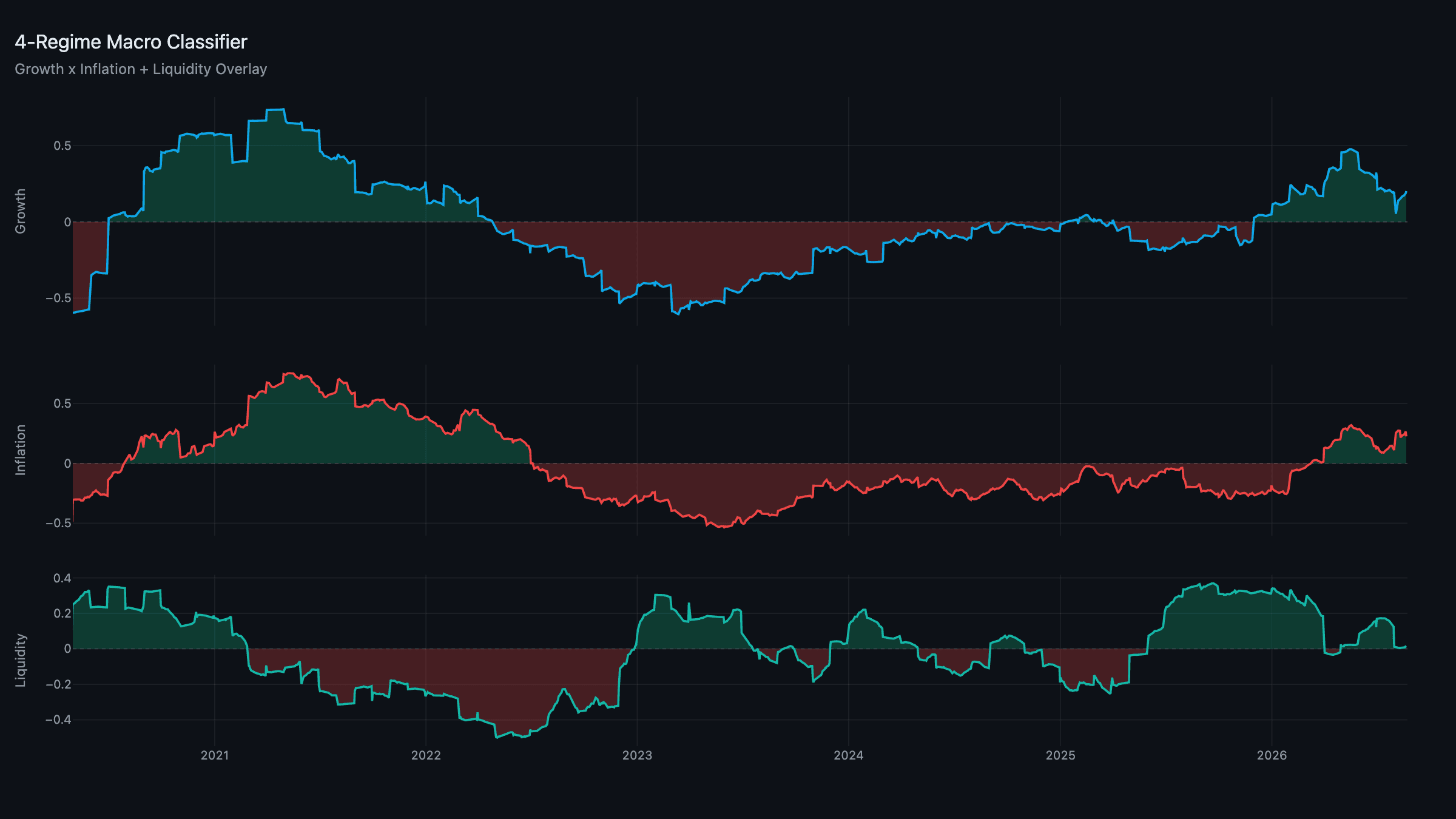
Composites: Liquidity Crosses Positive, Reflation/Expanding Returns
Liquidity closed at +0.02, its first positive print since liquidity flipped negative back in early August, a genuine regime change, not a boundary flicker. The composite has been grinding higher for over a week (0.004 on the 12th, climbing steadily to 0.015 by the 21st), and the driver is specific: collateral & funding (P5) improved to -0.57 from -0.62, its best read in weeks, while private credit (P2) and shadow banking (P4) held steady in the mid-0.3s. It's not a coincidence that the pillar tracking repo stress, SOFR volatility, and term-premium proxies is the one that moved the week the Treasury announced it would start buying back long-end bonds. That's exactly the kind of collateral and funding-market pressure a buyback is designed to relieve, and the composite picked it up almost immediately.
Growth firmed to +0.20, continuing its steady climb from the low 0.16s two weeks ago, with financial conditions (P1) now at +0.14 (its third straight week of improvement) and production (P4) jumping to +0.93. Distribution (P5) remains the one lagging pillar, still stuck at -0.30. Inflation sits at +0.22, elevated relative to the 0.17 we reported last week, though it's come off a mid-week peak near 0.26. Demand pressure and monetary conditions are still running firm, while expectations and services inflation stay comfortably negative. With growth and liquidity both confirming and inflation still short of a genuine problem, the regime reads Reflation / Expanding, the most constructive combination the framework produces, and the first time we've been back in it since early August.
The Portfolio: Weights Snap Toward Growth Without a Rebalance
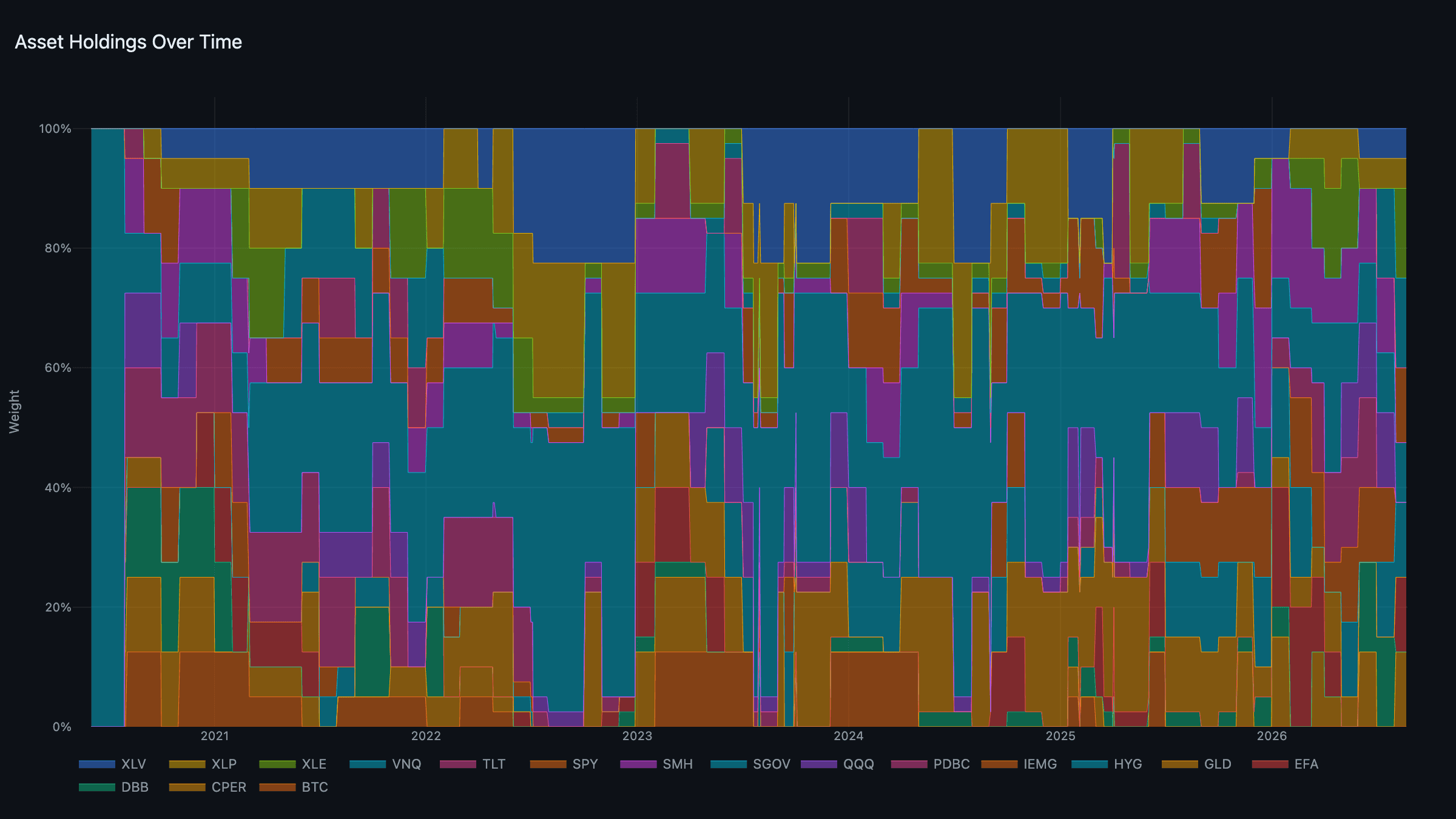
No tournament rebalance happened this week (the next scheduled run is still September 1st) but the book moved anyway, because the framework's sleeve weights are set by the current regime, not just re-derived at the monthly tournament. The moment liquidity confirmed Expanding, the base weighting scheme shifted from Reflation/Contracting's defensive posture to Reflation/Expanding's more constructive one:
- Real assets: VNQ + XLE, 15% each, unchanged.
- Growth: EFA + SPY, 12.5% each, up from 7.5%.
- Liquidity: CPER + HYG, 12.5% each, up from 5%.
- Cash: SGOV, 10%, down from 25%.
- Defensive: XLV + XLP, 5% each, down from 10%.
The sleeve winners themselves didn't change (the tournament's asset picks are still the same pairs from the August 1st run) but the regime flip alone cut cash by more than half and roughly tripled the growth and liquidity sleeves' combined weight, from 20% to 50%. Simulated backtest stats hold at 16.9% CAGR, 1.29 Sharpe, 1.53 Calmar, and a -11.0% max drawdown, largely unmoved since the shift is too recent to show up in trailing performance yet. This is a clean example of how the framework can de-risk or re-risk a book well before the next scheduled tournament run, purely off a regime confirmation.
News: The Buyback Shows Its Hand, the Debasement Trade Returns
The Treasury's announcement that it will buy back long-end bonds is fundamentally debt management, not stimulus. Long-end rates had gotten expensive enough that the math on servicing them simply wasn't working, and the buyback is the direct fix. No new money is being created here, so this isn't QE. But it does show the administration's hand: it's an acknowledgment that the debt problem is real and that action is coming, which has been our underlying thesis all along. There's a potential liquidity angle buried in here, but it isn't one yet, worth watching rather than assuming.
The move reads to us as a bull flattener, and that's the mechanical reason gold and bitcoin outperformed in its wake. The Treasury also signaled intent to shift new issuance toward the shorter end of the curve, reinforcing the flattening dynamic. Tech has become the largest capex-driven sector of this AI cycle, and capex-heavy sectors tend to underperform in a bull-flattener regime, while industrial activity (which leans more on credit availability than long-duration capital) tends to do comparatively better when the curve steepens instead. Worth tracking which of those two dynamics dominates from here, because it has real sector-rotation implications.
Earlier in the week, before the buyback announcement, rising yields alongside a stronger gold price were already telling the same story. Markets were losing faith in the Fed's willingness to keep hiking, with rate cuts looking increasingly likely and policy leaning toward sustaining growth rather than staying narrowly focused on inflation control. The buyback didn't create that signal. It confirmed one that was already forming.
Part of the rise in yields traces back to a debt outlook that isn't going away anytime soon, and that's a growing conviction of ours. Government debt combined with rising corporate issuance to fund AI capex is compounding pressure on the long end from two directions at once: sovereign and corporate borrowers competing for the same duration at the same time. That's the structural backdrop the buyback is responding to, not a one-off technical glitch.
Scott Bessent's comment that the US can grow its way out of debt as it crosses the $40 trillion mark makes the plan explicit. The message isn't to slow the economy to bring debt under control. It's to support growth aggressively enough that it outruns the debt load instead. That raises a real question worth sitting with: does this eventually mean another round of QE, with markets deliberately run hot to keep AI-driven growth going in the hope that growth alone resolves the debt problem rather than austerity or default?
Bessent and the administration are clearly signaling an intent to keep rates low to support growth, and that, by itself, lowers the real cost of government debt. A weaker currency and persistent inflation erode the nominal debt burden over time, even without ever explicitly restructuring anything. As Bessent framed it, this is an attempt to grow out of decades of accumulated debt. People are calling the "debasement trade" back into focus, but in our view it never actually left. It's been the central issue underneath nearly everything we've written about this year, and it's where we continue to position our own capital.
The buyback announcement is what brought scarce assets back to life, even though the buyback itself changes very little in practical terms. Gold and crypto re-rated not because the mechanics of a Treasury buyback move markets directly, but because of what it signals: rates staying low, growth prioritized over inflation control, and a government more willing to manage its way through a debt problem than confront it head-on. That signal, not the buyback's direct market impact, is the real story behind the move in scarce assets.
Separately, we don't buy the argument that Anthropic or OpenAI are losing pricing power because competitors offer cheaper tokens. Token price is only half the story. What actually matters is the capability behind the model and the total token spend required to complete a comparable task. A cheaper model that needs three times the tokens (or three times the retries) to reach the same quality answer isn't actually cheaper. On that basis, the frontier labs are still winning, even as headline per-token pricing compresses across the field.
There's ongoing debate over whether AI-driven earnings and revenue growth can keep holding up, and we think the durability case is stronger than the skeptics give it credit for. Compare life before and after AI became embedded in daily workflows. How much friction has simply disappeared. That kind of embeddedness is hard to walk back once people and companies have restructured how they work around it, which is the strongest argument we have for AI-linked earnings growth continuing rather than proving to be a temporary spike.
What's still missing for this growth scenario to fully play out (benefiting scarce assets and tech alike) comes down largely to oil. Despite some geopolitical de-escalation, oil and diesel prices remain elevated in the US, and they need to come down before the administration can meaningfully stimulate the economy further without reigniting the inflation side of the equation. Until that happens, the growth-over-everything plan has a real constraint sitting in the way.
Week Ahead
- Liquidity's Expanding confirmation: Whether the flip holds through another week of data or reverts toward the boundary the way it hovered for the past month.
- Collateral & funding (P5): The pillar that drove this week's move. Watch whether the buyback's effects continue showing up here or whether this was a one-time repricing.
- The buyback's liquidity angle: Not a liquidity event yet, per our own read, but worth reassessing weekly as the mechanics play out.
- Growth-vs-liquidity sleeve weights: Now the largest combined allocation in the book at 50%, the first real test of how that performs through a full week without the cash cushion.
- Oil and diesel prices: The key remaining constraint on further stimulus, and the variable most likely to determine whether the "grow our way out" plan has room to run.
All model scores are normalized to a [-1, +1] scale through our proprietary normalization methodology. Positive readings indicate above-trend expansion. Negative readings indicate below-trend contraction. Data updated through August 21, 2026.
MacroScope models are systematic tools, not investment advice. Past performance does not guarantee future results.