MacroScope Weekly, August 16, 2026
Current Regime: Reflation / Contracting Liquidity
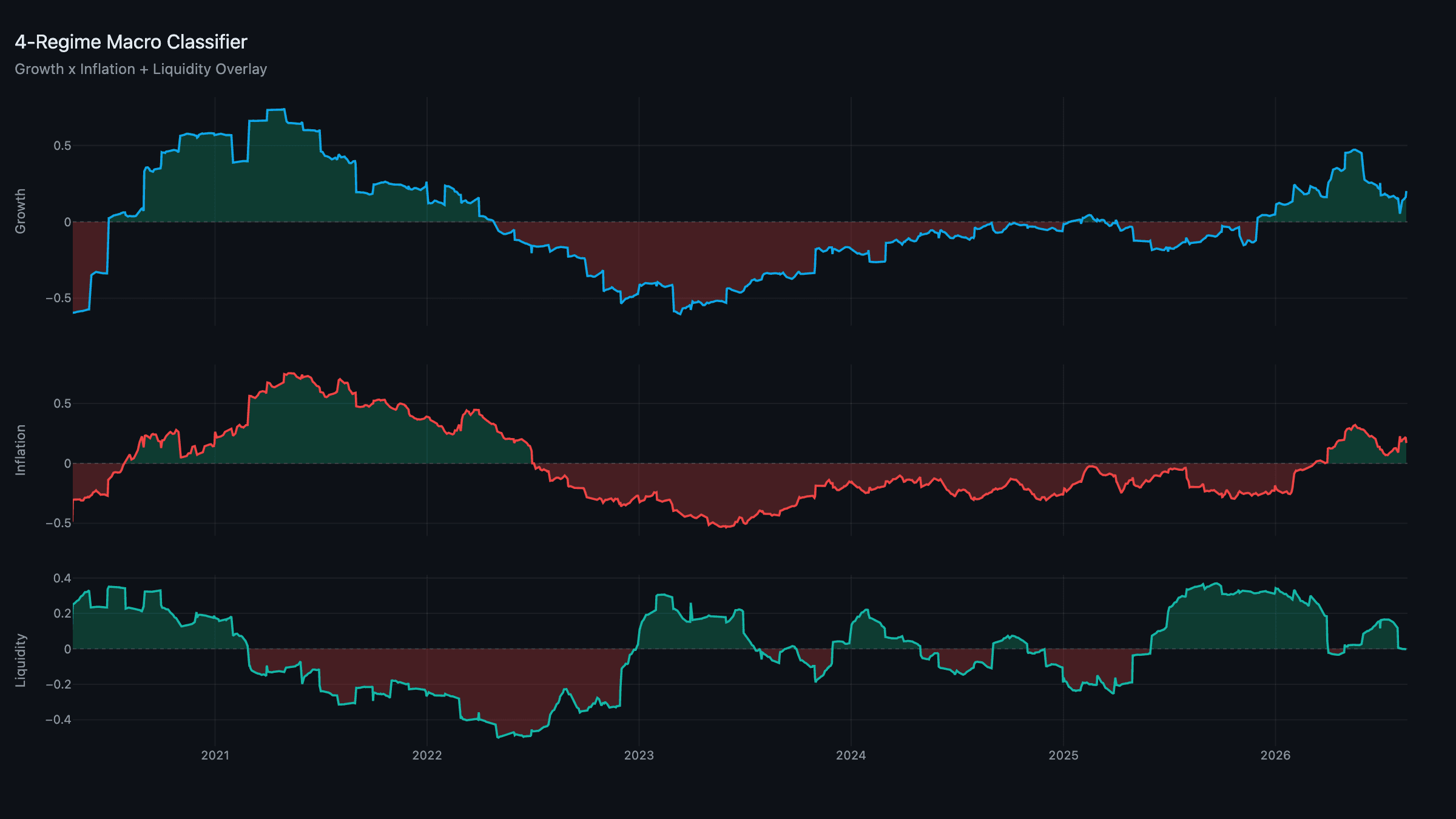
In short: Reflation / Contracting holds for a third straight week, but liquidity has stopped digging deeper. It's now essentially flatlined at -0.002, hovering right on the Contracting/Expanding boundary rather than continuing last week's slide. Growth firmed to +0.20, mostly on financial conditions (P1) crossing from negative to positive for the first time in weeks, while inflation eased back to +0.17 off a mid-week peak near 0.22. The portfolio carries its August 1st weights unchanged into the September 1st rebalance. Simulated backtest stats sit at 16.9% CAGR / 1.29 Sharpe / 1.53 Calmar / -11.0% max drawdown. On the news side: credit spreads are widening on the AI buildout without anything resembling crisis stress, which we read as the market simply pricing risk correctly rather than panicking. New data putting the AI capex boom's projected GDP impact ahead of the railroad boom reinforces our long-held view that Washington wants growth to outrun debt, not the other way around. Gold's revival and falling rate-hike odds on betting markets both look like the same trade. Investors concluding the Fed won't stand in the AI buildout's way. Airbnb's AI-driven 17% revenue growth is an early data point for the application layer being the next leg of this trade. Iran-driven inflation fears are, in our view, close to fully priced out. The US intervention to prop up the yen looks to have failed as the currency kept weakening anyway. Zuckerberg's open-source AI advocacy reads to us as a competitive position dressed up as an industry philosophy, and crypto's total lack of buzz right now has us watching closely, since disinterest this complete tends to precede the moves that matter.
Composites: Liquidity Stops Falling, Growth Firms on Financial Conditions
Growth rose to +0.20, up from the 0.11 to 0.16 range that held through most of the past two weeks, with financial conditions (P1) doing the real work. That pillar crossed from -0.18 to +0.02 over the same stretch, its first positive read in weeks. Input acquisition (P3) and production (P4) stayed firm in the 0.75 to 0.87 range, while distribution (P5) remains the laggard at -0.30, unchanged for over a week now. Inflation cooled to +0.17 after climbing as high as +0.22 mid-week. Demand pressure and monetary conditions are still running positive, but expectations and services inflation are both still comfortably negative and pulled the composite back down toward its recent range.
The more interesting move is liquidity, which has essentially stopped falling. After two weeks of sliding from positive territory into a genuine Contracting print, it's now sitting at -0.002, technically still negative, but close enough to flat that it reads as stabilization rather than continued deterioration. Private credit (P2) and shadow banking (P4) are both holding comfortably positive in the mid-0.3s, and cross-border (P3) is marginally positive. The drag is almost entirely coming from collateral & funding (P5), still stuck at -0.62 and unchanged for over a week, and central bank liquidity (P1) at a mild -0.10. The regime label stays Reflation / Contracting, but the internals now look like a liquidity backdrop finding a floor rather than one still actively tightening.
The Portfolio: Holding Steady Into September
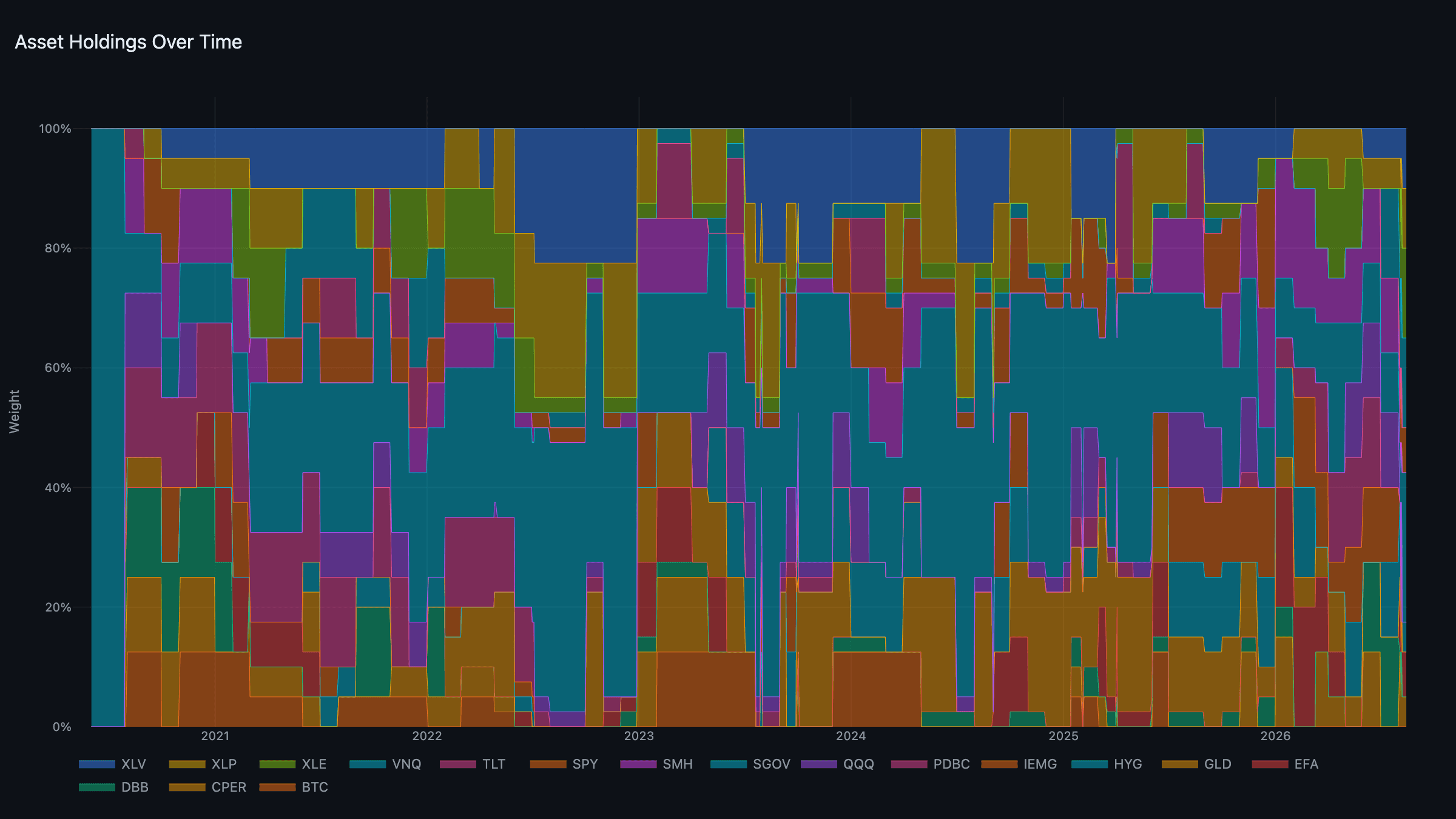
No rebalance this week. The book carries the August 1st weights, with the next tournament run scheduled for September 1st:
- Cash: SGOV, 25%.
- Real assets: VNQ + XLE, 15% each.
- Defensive: XLV + XLP, 10% each.
- Growth: SPY + EFA, 7.5% each.
- Liquidity: HYG + CPER, 5% each.
Simulated backtest stats moved slightly in favor of the book this week: 16.9% CAGR, 1.29 Sharpe, 1.53 Calmar, and a -11.0% max drawdown, modest improvement in the risk-adjusted numbers even with the raw CAGR essentially flat, consistent with a market that's chopped sideways without much net direction over the past two weeks. Nothing structural changes here until September 1st, when the tournament gets a fresh look at all five sleeves.
News: Credit Prices the AI Buildout Correctly, Gold Reads the Fed, and Crypto Goes Quiet
Credit spreads on AI-buildout-linked debt widened this week, and we think that's the market doing exactly what it should be doing. Lenders and bondholders are demanding to be compensated fairly for the risk of funding hundreds of billions in data center and infrastructure buildout. That's a rational repricing of risk, not a warning sign. Crucially, there's no accompanying stress in the usual crisis indicators: no disorderly widening, no liquidity seizing up, nothing that looks like a credit event brewing underneath. This is a market charging a fair premium for a genuinely large, genuinely uncertain bet, which is a healthy function of credit markets working as intended rather than a red flag.
New data projecting the AI capex boom's GDP impact to exceed the railroad boom (and still rising) is exactly the kind of evidence that supports our long-standing view of what the Fed and the US government are actually optimizing for. If growth from AI investment can outpace the growth in debt issued to fund it, that's the mechanism by which an economy actually grows its way out from under an enormous debt load rather than defaulting or inflating it away. That's the race Washington is running, and it explains a policy posture that consistently favors supporting the AI industry over fighting it. The catch, and it's a real one: the primary near-term driver of AI capex is debt issuance and financing, not organic cash flow, which means the debt picture is very likely to look worse before this thesis has a chance to prove itself. We think that's a cost worth paying if the growth materializes, but it does mean bracing for the debt numbers to get uglier in the interim, not expecting a clean, steady improvement from here.
On that note, we remain skeptical of the tighter-monetary-policy case, and it's not on our radar as a near-term risk. Some are arguing the Fed needs to lean hawkish to keep the AI-financing boom from overheating. We don't buy it. A Fed that wants the AI buildout to succeed has every incentive to keep financing conditions easy for the people building it, not make their capital more expensive. This is effectively the government's chosen path out of the debt trap, and you don't tighten the screws on the industry you're counting on to solve your biggest structural problem.
Gold's revival this week looks to us like the same trade as the falling rate-hike odds on prediction and betting markets, just priced through a different asset. Both are consistent with investors concluding, after the last several Fed meetings, that a hike is increasingly unlikely and that the Fed is more interested in supporting AI-driven growth than in aggressively restraining the economy. That's not really a loss of confidence in the Fed's competence so much as a correct read of its priorities. The market is pricing in a central bank that has chosen sides in the growth-versus-debt tension, and gold moving higher alongside falling hike odds is two markets independently arriving at the same conclusion.
Airbnb said AI is the best thing to have happened to the company, and 17% year-over-year revenue growth is a real number behind that claim, not just a talking point. This is worth watching closely as a potential signal that the application layer (companies actually deploying AI into existing products rather than building or supplying the underlying models) could be the next leg of this trade to run. It fits the broader "who actually monetizes AI" question we've been tracking: model builders got rewarded first, then chip suppliers, and a real, measurable revenue lift at an established consumer platform is exactly the kind of evidence that would mark the start of the adoption phase actually showing up in the numbers.
We continue to see an extremely slim chance of Iran-driven inflation forcing a rate hike, close to zero, in our view. The inflationary pressure from the conflict looks to us like it peaked already. Both energy prices and the broader oil market have calmed down meaningfully. We don't see Warsh willing to hike off an inflation print driven by what looks like a temporary, geopolitically-driven energy spike, particularly when the underlying policy problem (debt refinancing and clearing the runway for the AI buildout) points firmly in the opposite direction. A hike here would work against the one lever the Fed seems most committed to pulling.
The US intervention to prop up the yen appears to have failed. The currency kept weakening through the week despite it. Our read on the original motivation was less about the yen itself and more about protecting US Treasury yields: a sharply weakening yen raises the odds Japan sells Treasuries outright to fund yen purchases and defend its currency, and that's a forced-seller scenario Washington wants to avoid given how sensitive yields already are. With the intervention not holding, the open question is whether this pushes toward a second, larger round of intervention, or whether Washington and Tokyo tolerate further yen weakness rather than escalate a defense that already looks like it isn't working.
Zuckerberg's renewed push for more open-source AI models reads to us as a competitive position wearing an industry-philosophy costume. There's a genuine public-good argument here. Open models let the whole field iterate faster and could meaningfully speed up progress across the board. But the incentive underneath is straightforward: openness helps whoever is behind catch up faster, and it structurally erodes the lead of whoever's currently ahead. For a company that isn't leading the frontier the way OpenAI or Anthropic currently are, advocating loudly for openness is a rational strategy dressed up as altruism, good for the field in aggregate, but not obviously good for the leaders being asked to open up.
Crypto has gone remarkably quiet, and that quiet is itself the signal worth paying attention to. No buzz, no hype cycle, fear has cooled to something closer to indifference. It's almost a rule of thumb that the most interesting moves happen exactly when crowds have stopped paying attention. Apathy is a much better setup for a real move than a market still working off excess euphoria or excess fear. We don't have a specific catalyst to point to, but the current nothingness reads to us as the calm that tends to precede a genuinely interesting period, not a market that's simply dead.
Rate-hike odds continue drifting lower on betting markets, and we think that's a genuine positive for risk assets from here. We've held this view for a while: the Fed would rather hold or cut than hike, both to keep debt rollover cheap and to keep capital cheap for the AI sector it's clearly betting on for sustained GDP growth over the next decade. As markets increasingly price out hike risk, that should translate into real stability, fewer sudden repricings around Fed meetings, and room for more sustained rallies rather than the choppy, headline-driven trading of the past couple of months. The wildcard, as always, is Iran: continued de-escalation toward some kind of agreement would remove the one variable that could still force the Fed's hand, and clear the path for the easier, calmer market backdrop we think is otherwise coming into view.
Week Ahead
- Liquidity's flatline: Whether -0.002 marks a genuine floor or just a pause before either a return to Expanding or a resumption of the Contracting slide.
- Collateral & funding (P5): Still stuck at -0.62 and the single biggest drag on the liquidity composite. Watch for any movement here specifically.
- AI application-layer earnings: Whether Airbnb's 17% AI-driven growth is an outlier or the first of a broader pattern across consumer and enterprise platforms.
- Yen intervention: Whether continued weakness triggers a second, larger defense, or whether Washington and Tokyo tolerate further depreciation.
- Iran de-escalation: The key swing variable for whether rate-hike odds keep falling and markets find the calmer footing we expect, or whether renewed escalation reopens the inflation-hike debate.
- September 1st rebalance: The next scheduled tournament run, and the first real test of whether the current sleeve winners hold.
All model scores are normalized to a [-1, +1] scale through our proprietary normalization methodology. Positive readings indicate above-trend expansion. Negative readings indicate below-trend contraction. Data updated through August 14, 2026.
MacroScope models are systematic tools, not investment advice. Past performance does not guarantee future results.