MacroScope Weekly, August 2, 2026
Current Regime: Reflation / Contracting Liquidity
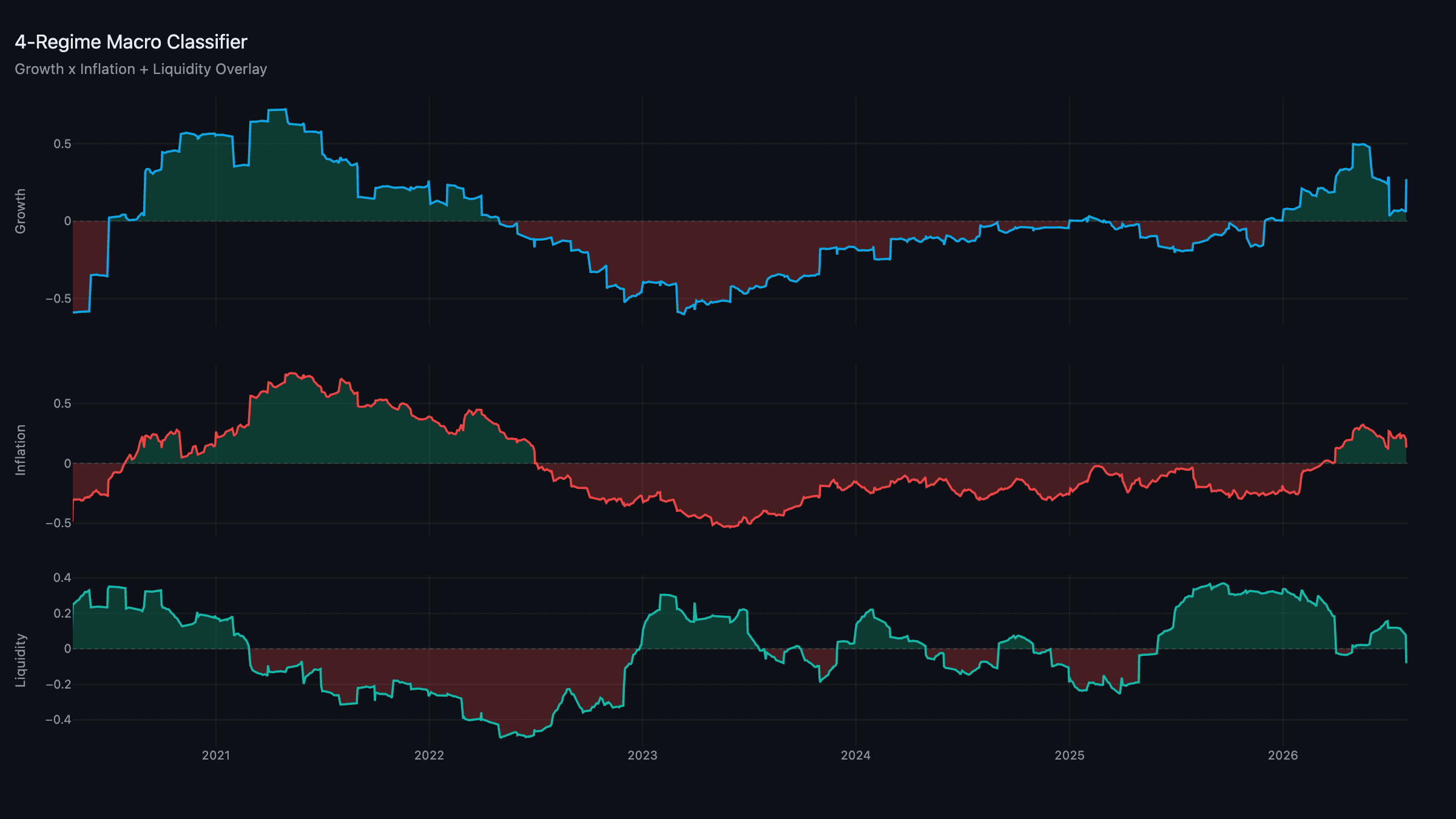
In short: The overlay flips: Reflation / Contracting replaces Reflation / Expanding as liquidity dropped to -0.23 from the low single digits, crossing into negative territory for the first time since the framework's Expanding read began. Growth jumped to +0.44 on the month-turn data refresh and inflation held near +0.13. The August 1st tournament rebalance landed hard on the defensive side: cash (SGOV) now carries 55% of the book after the real-assets sleeve came back unavailable and routed straight to cash, on top of Reflation/Contracting's already cash-heavy base weights. On the news side: the Fed held rates but Warsh's press conference left markets genuinely confused, with language that reads as quietly dovish to us. NVIDIA's CDS spreads widened on capex-payback fears even as we think the market has the capex debate backwards. Tariff headlines have stopped moving markets entirely, and the AI trade's "specialization era" is opening real room for cheaper Chinese models even as the US administration weighs whether to let them stay.
Composites: Liquidity Flips Negative
Liquidity crossed the line to -0.23, down from a slow bleed through the low positive single digits over the back half of July (+0.03 on the 21st, grinding to -0.04 by the 30th) before the month-end data refresh pushed it decisively negative. That's the move that matters this week: the liquidity overlay is now Contracting for the first time since the framework flipped Expanding back in June. Growth jumped to +0.44, a sharp move off a flat ~0.13 range that held for most of the prior two weeks, consistent with fresh monthly prints (ISM, payrolls-adjacent data) landing at the month turn rather than a genuine single-day inflection. Inflation held essentially flat at +0.13.
The regime is now Reflation / Contracting, still expansionary on growth, still short of a real inflation problem, but with the liquidity backdrop turning from tailwind to headwind. Historically this is the combination where the framework's own weighting scheme gets meaningfully more defensive (see below), and it's worth taking seriously rather than dismissing as a one-print noise event given how directional the liquidity slide had already been running into month-end.
The Portfolio: The Tournament Goes Defensive
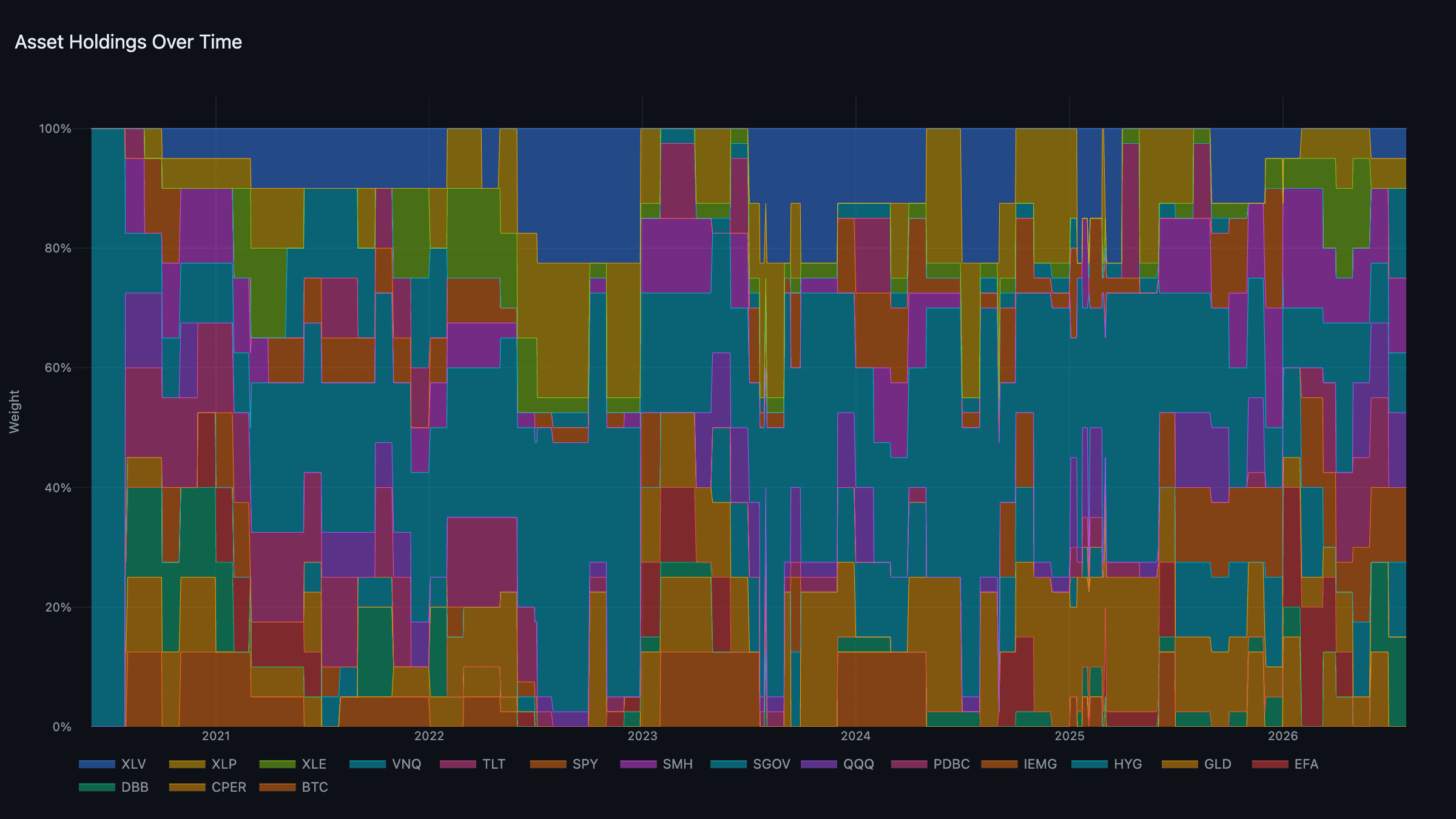
The August 1st rebalance was the sharpest rotation since the July 1st book, and it landed almost entirely in cash:
- Cash: SGOV, 55%.
- Defensive: XLV + XLP, 10% each.
- Growth: EFA + SMH, 7.5% each.
- Liquidity: CPER + HYG, 5% each.
- Real assets: unavailable this cycle. The pool's momentum signal couldn't be computed, so its full weight routed straight to cash.
Two things are stacking on top of each other here. First, Reflation/Contracting's base weighting scheme is already the more defensive combination: 25% cash and 20% defensive by design, against just 15% growth and 10% liquidity. Second, the real-assets sleeve (DBB + VNQ) came back entirely unavailable this cycle, and per the tournament's own rules, a pool with no usable signal routes its full allocation to cash rather than forcing a pick, pushing the base 25% cash weight up to 55%. It's a mechanical outcome, not a discretionary de-risking call, but the practical effect is the same: the book is now overwhelmingly in cash and short-duration paper heading into a month where the Fed's own signal is genuinely unclear (more below). Simulated backtest stats on the new book: 15.2% CAGR, 1.25 Sharpe, 1.21 Calmar, and a -12.5% max drawdown.
News: The Fed Confuses Everyone, NVIDIA's Debt Gets Watched, and the AI Trade Isn't Dead
The Fed held rates, and Warsh's press conference left the market more confused than reassured. That was the headline outcome, but the more interesting story is in the details markets are still arguing over: several of his comments read to us as quietly dovish, even though the on-paper decision was a hold. References to looking past headline PCE toward other inflation gauges, and to tools other than the policy rate for fighting inflation, are not the language of someone gearing up to hike. Our read is that this could be a deliberate bet, leaning into AI-driven growth and letting it outrun the debt and inflation problem rather than fighting inflation head-on with higher rates. The logic tracks with what we've been saying for months: the binding constraint on this Fed isn't a transitory, war-driven oil price spike, it's the sheer volume of debt that needs to be refinanced, and that problem gets easier to manage the longer rates stay where they are, not higher. We don't expect the Hormuz-driven inflation bump to be enough on its own to force Warsh's hand into a hike. The debt math dominates.
NVIDIA's credit default swaps widened this week, and that's a sharper signal than the equity selloff itself. The capex-payback question (whether the hundreds of billions being plowed into AI infrastructure will actually generate a return) has been simmering for weeks, but CDS spreads moving is a different kind of tell: it's the fixed-income market pricing in a real, if still small, probability of credit stress, not just an equity multiple getting compressed. That's worth taking seriously as a signal of where sentiment actually sits beneath the surface. Where we differ from the bearish read: we think the market currently has this backwards. Microsoft rallied this week specifically because it showed a capex deceleration, while the names still leaning hardest into AI buildouts got sold. The market is rewarding capital discipline and punishing investment right now. Our view is that this inverts over the long run. The companies building the deepest AI infrastructure today are laying the foundation for what becomes some of the strongest franchises of the next decade, not overspending on a fad that fades. Pulling back capex to please this quarter's tape is the easier trade, not the smarter one.
On that note: we remain baffled by how many people are calling the AI trade dead after a few sluggish weeks. A couple of weeks of underperformance, some hand-wringing over Google's capex line, and a bit of chip-stock chop is not evidence a multi-decade infrastructure buildout has ended. The right question to ask about a trade like this isn't "does this feel over," it's "has the thing that was actually driving it stopped", and by that test, nothing here qualifies. This reads to us as early innings, not last call.
Tariff headlines have officially stopped moving markets. The administration has pushed tariff announcements so relentlessly over the past several months that the market has simply gone numb to them. Both last week's and this week's tariff news landed with essentially zero price reaction. That's a real regime change in how markets process this particular risk: instead of being caught off guard by each new announcement, positioning now prices tariff risk on a continuous, rolling basis rather than repricing in discrete jumps. It's the same dynamic we've flagged with Hormuz. Repetition dulls the shock value of a risk even when the underlying policy keeps escalating.
China's growth slowdown and soft consumer spending are setting up the case for fresh fiscal stimulus, and the target this time looks less like broad-based consumption support and more like a direct shot at competing with US technology leadership. A slowing domestic economy combined with a government that clearly wants to keep pace with (or overtake) American AI and semiconductor capability is a combination that tends to produce targeted industrial stimulus rather than the blunt infrastructure spending of prior cycles. Worth watching for read-through into the growth composite's cross-border channels if it materializes.
The AI industry's "tokenmaxxing" era looks like it's ending, and that's opening a real opportunity for cheaper Chinese models. For the past couple of years the competitive framing was largely about raw scale: biggest model, most tokens, most general-purpose capability. That's shifting: most labs and their enterprise customers now seem to understand that a more qualitative approach (building or choosing the model that's genuinely best at one specific task rather than good at everything) gets more value per dollar. That's exactly why a tool like Claude Code being purpose-built and best-in-class for coding is a real competitive advantage rather than just a marketing label. But specialization cuts both ways: it also means a cheaper, narrower model from a lab like DeepSeek or Moonshot can be "good enough" for a specific task at a fraction of the token cost of its American counterparts. The open question is what those labs aren't spending on to get there: user experience polish, security hardening, alignment and safety work are all real costs that don't show up in a benchmark score but absolutely show up in enterprise trust, and that's still an area where the US labs are clearly ahead. The bigger wildcard is political, not technical: whether the Trump administration takes steps to keep American enterprise and consumer usage on American models, given the obvious national-security angle of routing sensitive workloads through Chinese-controlled infrastructure.
Week Ahead
- Liquidity's Contracting flip: The first Contracting print since June. Watch whether it's a genuine trend change or a single sharp data revision that partially reverts.
- Real-assets sleeve: Watching whether DBB/VNQ signal availability returns for the next rebalance, since that alone drove roughly half the cash build this cycle.
- NVIDIA CDS: A credit-market signal worth tracking independently of the equity tape. A further widening would be a materially different story than a stabilization here.
- Fed communication: Whether Warsh's ambiguous tone gets clarified or whether the market continues trading a dovish read into a technically neutral hold.
All model scores are normalized to a [-1, +1] scale through our proprietary normalization methodology. Positive readings indicate above-trend expansion. Negative readings indicate below-trend contraction. Data updated through July 31, 2026.
MacroScope models are systematic tools, not investment advice. Past performance does not guarantee future results.