MacroScope Weekly, July 26, 2026
Current Regime: Reflation / Expanding Liquidity
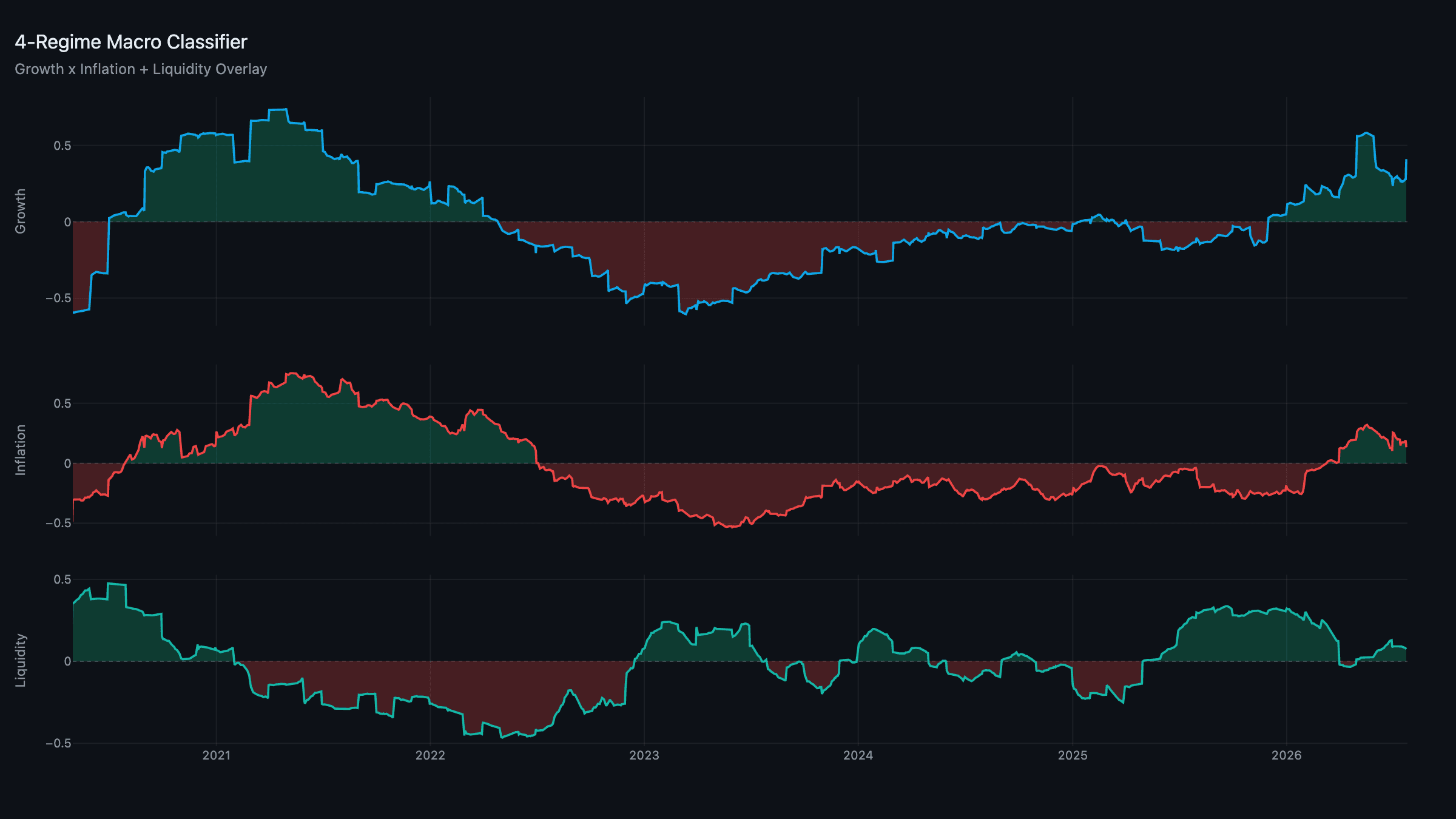
In short: Reflation / Expanding holds. Growth firmed to +0.41, extending its climb out of the 0.26 to 0.28 range it sat in for most of the last two weeks. Inflation cooled to +0.13 from the high-0.18s, and liquidity eased slightly to +0.07, still comfortably inside Expanding territory. The portfolio carries its July weights unchanged with the tournament rebalance now just days away on August 1st. On the news side: Kimi K3's runaway popularity ran headlong into a demand wall: outages and closed signups that read as another data point for the semiconductor-demand story, not a knock against it. The Iran conflict keeps grinding on a rolling basis rather than escalating in one shot, capping the oil move for now. Trump's Truth Social is reportedly selling early access to his market-moving posts. The chip-stock pullback looks like a momentum air pocket rather than a trend change. The London Stock Exchange announced a 24/5 trading model. Japanese long-end yields kept ripping higher in a preview of a problem the US shares. Novo Nordisk sued Eli Lilly over its marketing, and OpenAI leaned back into its core product with a reported doubling of ChatGPT's user base.
Composites: Growth Keeps Climbing, Inflation Cools Further
Growth rose to +0.41, building on the move higher out of the mid-0.20s range that held for most of the back half of July. The composite has now strung together several consecutive sessions of improvement rather than a single-day spike. Inflation eased to +0.13 from the high-0.18s the prior week, a continuation of the drift lower even with Hormuz-related oil volatility still in the background. Liquidity softened marginally to +0.07, still positive and still Expanding, but the pillar with the least room left before it would need watching.
The regime stays Reflation / Expanding. With growth firming and inflation still cooling, the framework's read is a cycle that's reasserting itself without yet generating the kind of price pressure that would force a regime change. The open question, as it has been for weeks, is whether Hormuz-driven energy costs eventually show up in the pipeline-costs channel before growth's improvement runs its course.
The Portfolio: Holding Into the August 1st Rebalance
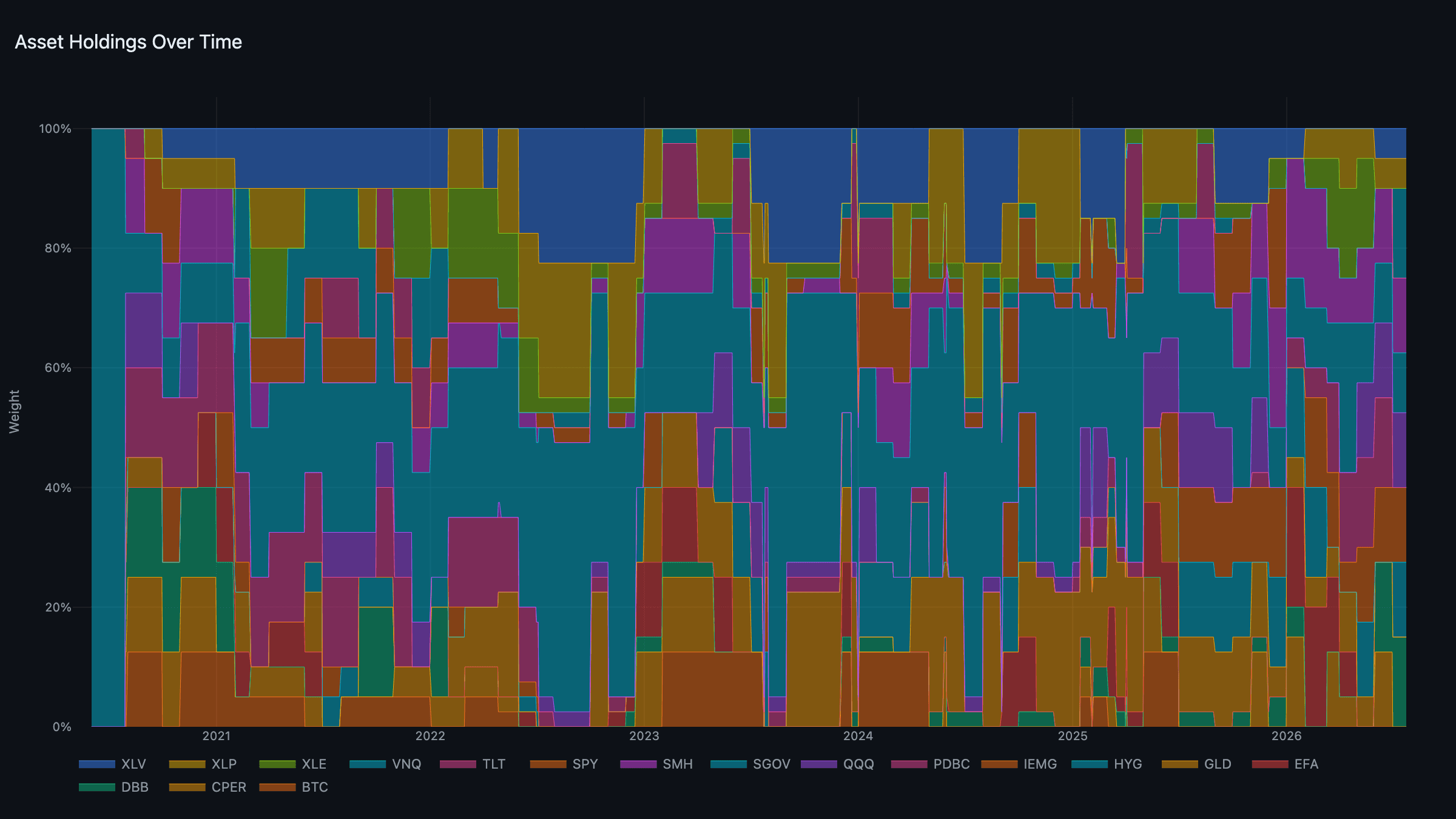
No rebalance this week. The book carries the July 1st weights into the final stretch before the next scheduled tournament run:
- Real assets: DBB + VNQ, 15% each.
- Growth: QQQ + SMH, 12.5% each.
- Liquidity: IEMG + HYG, 12.5% each.
- Defensive: XLV + XLP, 5% each.
- Cash: SGOV, 10%.
Simulated backtest stats on the current book: 15.5% CAGR, 1.20 Sharpe, 1.40 Calmar, and a -11.0% max drawdown. The growth sleeve (QQQ + SMH) is the one to watch into August 1st. Semis have been the more volatile half of that pairing over the past couple of weeks (more on that below), and the tournament will decide whether that volatility gets rewarded with continuity or triggers a rotation.
News: A Chip Demand Wall, a Grinding Oil War, and Yields Breaking Out in Tokyo
Kimi K3's popularity became its own bottleneck, and that's a semiconductor story as much as an AI one. The model's main competitive threat to tools like Claude Code is straightforward. Coding is probably the single largest use case for Claude Code's average user, and Kimi K3 is priced and positioned to compete directly for that workload. It's also worth asking whether the persistent gap between Chinese and Western frontier models (Kimi included) partly reflects those labs training on the outputs of the US frontier models they're chasing, rather than closing the gap independently. But the more interesting signal this week wasn't about model quality, it was about capacity: the surge in usage was large enough to cause outages and force the lab to close new signups entirely. A demand shock big enough to break a product is a demand shock, full stop, and it's another mark in favor of the view that semiconductor demand isn't cooling. It's still outrunning supply, which is the core argument behind the run in semi stocks continuing rather than topping out here.
The Iran conflict is still active, but it's grinding rather than escalating. The US has kept up consecutive strikes, and the Strait of Hormuz is still constraining a meaningful share of tanker traffic, keeping oil prices elevated. But there's been no further escalation beyond that baseline, and the market increasingly seems to be pricing the risk on a rolling, day-by-day basis rather than repricing it all at once the way it did when the conflict first broke out, which is exactly why the impact on prices has been muted relative to the initial shock. Oil sustainably back above $100 looks unlikely absent a genuine escalation from either side. There's a case that the push-and-pull here is actually mean-reverting: both the US and Iran have real economic exposure to where oil settles, and as prices grind toward the upper end of the range, that exposure itself becomes the thing that pulls the conflict back from further escalation. If that's right, this stays a rolling, capped risk rather than a one-way ratchet, until proven otherwise.
Trump's Truth Social is reportedly selling early access to his posts, and that looks a lot like legalized insider information by another name. His posts have a well-established track record of moving markets, and a paid early-access tier effectively monetizes that lead time. It's the kind of arrangement that only makes economic sense for firms large enough to justify the fee against the trading edge it buys, which is exactly the audience it appears to be built for.
The chip-stock pullback looks like an air pocket, not the top. Momentum strategies are often described as taking the stairs up and the elevator down, and the semiconductor trade's stumble over the past couple of weeks is a clean example of the elevator. A trade that had gotten visibly overextended taking a sharp, fast leg lower, which is the part of running a momentum strategy that has to be accepted rather than avoided. But an elevator ride down a few floors isn't the same as leaving the building: the underlying, coincident data that's been driving the trend (Korean export figures chief among them) hasn't turned over. Until that slows, this reads as investors stepping off at the wrong floor and continuing to climb the stairs, not the end of the move.
The London Stock Exchange announced plans for a 24/5 trading model, a genuine structural first for a major exchange and a likely template for others to follow. The open question is the infrastructure underneath it. Round-the-clock settlement and matching at that scale is the kind of problem blockchain-based settlement rails are pitched as solving, and this is the sort of initiative that could end up being the proof of concept the technology has been waiting for.
Japanese long-end yields kept breaking higher, a move that's been building for a long time under yield-curve-control suppression and is now running with real momentum, like a rocket that spent years fueling on the pad. It's hard not to read this as a preview of a problem the US shares: both countries have leaned on suppressed long-end yields to manage an ever-growing debt load. The difference is timing, not kind. Our read is that the US isn't ready to let its own long end run the way Japan's just has, because the underlying debt problem still needs low rates to be managed rather than solved. That means more time on the pad, not liftoff, until a different fix for the debt trajectory is in hand.
Novo Nordisk is suing Eli Lilly over its marketing campaign, and the timing reads like frustration more than strategy. The move comes after Novo lost its long-held lead in the GLP-1 category to Lilly. It has some of the flavor of a team taking shots at the other side's bench players after the game has effectively gotten away from them, except the game here is still very much live. Even a successful suit that forces Lilly to pull the campaign in question is unlikely to hand Novo back the lead. That only happens with a better product, not a courtroom win.
OpenAI is visibly leaning back into its core product as competition heats up from both Chinese labs and domestic rivals. The company has pulled back from side projects to refocus on its main money-makers, and paired that shift with a well-timed announcement that ChatGPT's user base has doubled to roughly 10 million for the month on its core services. Refocusing on the flagship product while the competitive floor is rising under you is a defensible move, but the framing of the announcement (leading with a growth number right as the competitive narrative turns against you) is itself a tell about how seriously the pressure is being felt internally.
Week Ahead
- August 1st rebalance: The tournament decides whether the growth sleeve's recent volatility gets rewarded with continuity or triggers a rotation. The first real test since the July 1st weights were set.
- Hormuz: Still a rolling, capped risk rather than a one-time shock. Watch for any sign of genuine escalation that would break the current mean-reverting pattern.
- Semis and Korean exports: The read-through for whether the chip trade's pullback was an air pocket or a top. A slowdown in the underlying export data would be the signal that changes the call.
- Chinese AI demand: Whether Kimi K3's outages and closed signups are a one-week capacity problem or a sign that Chinese labs are structurally supply-constrained even as usage grows.
All model scores are normalized to a [-1, +1] scale through our proprietary normalization methodology. Positive readings indicate above-trend expansion. Negative readings indicate below-trend contraction. Data updated through July 24, 2026.
MacroScope models are systematic tools, not investment advice. Past performance does not guarantee future results.