MacroScope Weekly, July 19, 2026
Current Regime: Reflation / Expanding Liquidity
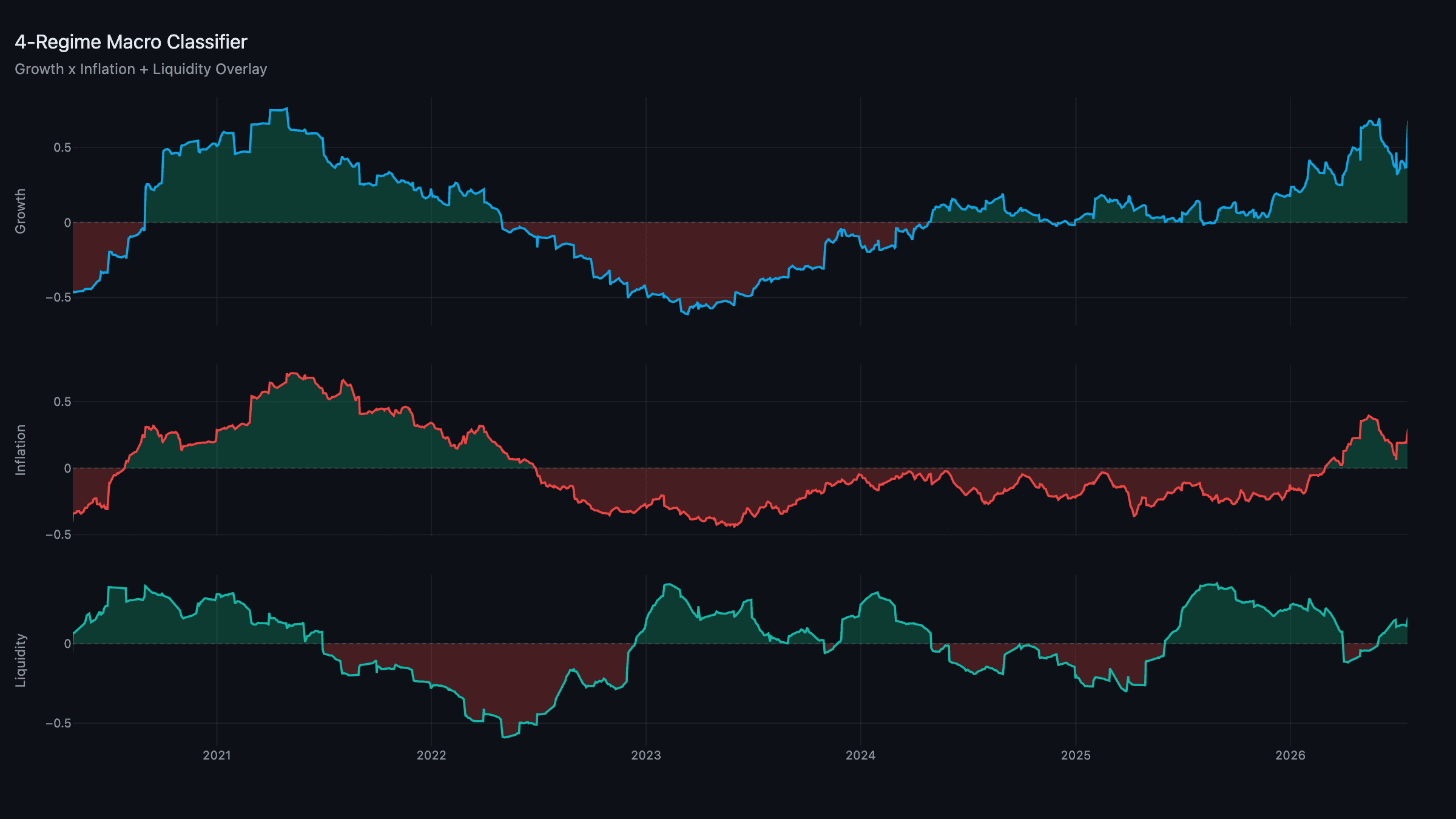
In short: Reflation / Expanding holds, and growth put in its sharpest single-day jump in months, snapping from +0.37 to +0.67 as the composite broke out of the mid-30s range it had held since the start of the month. Inflation eased to +0.19 and liquidity held steady at +0.11. The portfolio carries its July 1st weights unchanged into the back half of the month. The dominant story was Iran breaking the ceasefire and the US launching fresh strikes alongside new restraints on Iran's oil exports, reopening the Hormuz tail risk with no truce left to fall back on. Elsewhere: a softer CPI print revived the rate-cut case even as consensus positioning still leans toward hikes, bank earnings leaned harder on trading than lending, private credit funds hit a redemption bottleneck, and consumers kept shifting from expensive US AI products to cheaper Chinese ones.
Composites: Growth Breaks Out
Growth surged to +0.67, up from +0.37 the prior session and the sharpest one-day move the composite has posted since the current framework launched, a genuine breakout, not a rounding artifact, after nearly three weeks pinned in the 0.35 to 0.40 range. Inflation eased to +0.19 from the mid-0.19s, a small but continued drift lower that lines up with the softer-than-expected CPI print discussed below. Liquidity held essentially flat at +0.11, comfortably inside Expanding territory with no pillar showing stress.
The regime stays Reflation / Expanding for another week. With growth reasserting itself this sharply, the framework's read is that the cycle is still firming. The open question is whether the renewed Hormuz volatility (below) starts to show up in the inflation composite's pipeline-costs channel before the next print.
The Portfolio: Holding the July Book
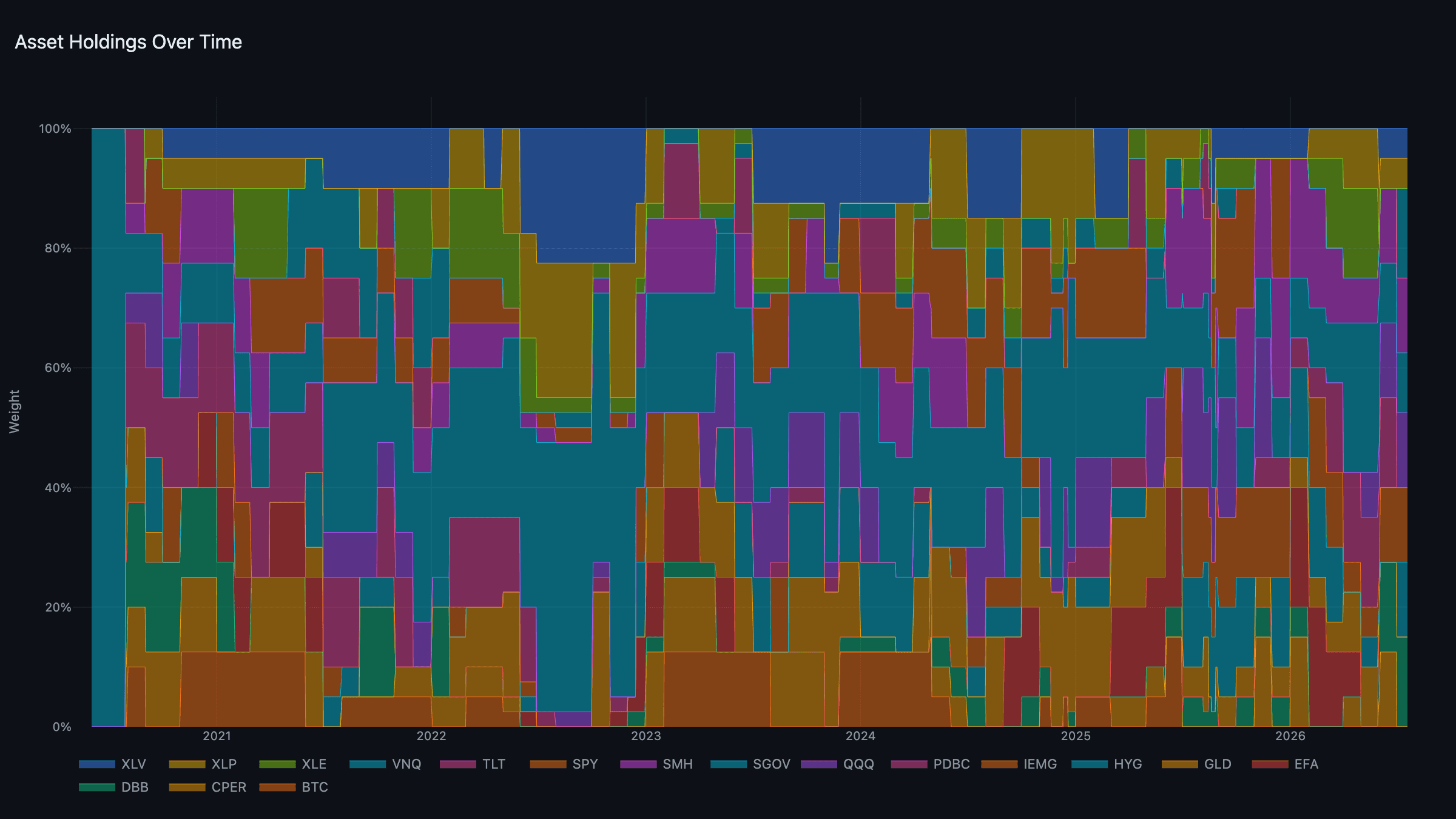
No rebalance this week. The book carries the July 1st weights unchanged, with the next scheduled tournament run at month-end:
- Real assets: DBB + VNQ, 15% each.
- Growth: QQQ + SMH, 12.5% each.
- Liquidity: IEMG + HYG, 12.5% each.
- Defensive: XLV + XLP, 5% each.
- Cash: SGOV, 10%.
With growth's composite breakout this week, the growth sleeve is the one to watch heading into the August 1st rebalance. A sustained move like this is exactly the kind of signal the sleeve tournament rewards with added conviction, assuming it holds up rather than mean-reverting over the next few sessions.
News: Hormuz Flares Up Again, CPI Reopens the Cut Debate, and Cheaper AI Wins Consumers
Hormuz stopped being a background risk and became the week's most volatile story. Iran broke the ceasefire deal outright, and the US responded with a fresh round of led attacks along with new restraints on Iran's oil business. Sanctions and enforcement aimed squarely at the export revenue the regime depends on. The immediate market reaction was a sharp, choppy move in Brent and tanker/insurance rates as traders repriced the odds of an actual Strait closure rather than just a rhetorical threat. What matters going forward is that this isn't a one-off headline that gets absorbed and forgotten. The ceasefire's collapse means the uncertainty is now open-ended, with no framework left holding the tail risk down. That keeps the inflation composite's pipeline-costs channel on a hair trigger: a real disruption at Hormuz would flow through fast, and unlike the past few months, there's no truce left to fall back on if this escalates further.
CPI came in below expectations, though positioning hasn't budged yet. The broad consensus, and where most desks are still positioned, remains toward hikes rather than cuts. That's still the dominant view heading out of the print. Our own read is a bit different: a softer CPI print makes it easier, not harder, for the Fed to justify cutting, and cutting is arguably what they actually want to do. The biggest problem sitting under this economy isn't inflation itself, it's the sheer volume of debt that needs to be refinanced and rolled over, and that problem gets meaningfully easier to manage at lower rates. A cooler CPI print gives the Fed cover to lean that direction without looking like it's ignoring inflation, even while the loudest voices in the market are still talking about hikes.
Bank earnings season leaned heavily on markets, not lending. Across the large banks that reported, the swing factor in the beat-or-miss was trading and capital-markets revenue (equities and fixed-income desks, underwriting fees, wealth management) rather than net interest income or loan growth. It's a read-through worth flagging for the growth composite: bank profitability that tracks market activity more than credit extension is a more fragile source of earnings, since it can reverse quickly if volatility or issuance dries up, even while headline EPS looks fine.
Private credit's liquidity mismatch showed up in the open. Several large private-credit vehicles hit their quarterly redemption gates this week, a structural feature that's rarely tested until it is: investors can request cash back only on a quarterly cadence, and funds hold thin cash buffers against portfolios of illiquid loans. When redemption requests bunch up (as they did this week) the mechanical gate kicks in and withdrawals get pro-rated or delayed, not because the underlying loans defaulted, but because the vehicle was never built to convert a wave of simultaneous demands into same-day cash. It's the same liquidity-mismatch structure that has caused stress in open-ended property and credit funds before, just with a different collateral type this cycle.
On the consumer side, users are switching from expensive US AI products to cheaper Chinese ones. This isn't an investing rotation. It's a usage one. With several Chinese AI models now closing much of the quality gap while charging a fraction of the price (or giving the product away outright), everyday users and smaller businesses are visibly shifting spend away from the premium US subscriptions and toward the cheaper alternatives. That's a real threat to the pricing power the US AI leaders have been counting on to justify their valuations: if "good enough for a lot cheaper" keeps winning consumer wallets, it puts pressure on the revenue side of the AI story well before it shows up in any earnings report.
Stock market leverage is building, and it looks less like a late-cycle pattern than a new-regime one. The old valuation playbook (price stocks off the cash they actually generate) is looking less and less relevant to how this market is being priced. Margin debt and derivatives-embedded leverage keep climbing while free-cash-flow growth increasingly isn't the thing doing the work: what's propping valuations up is closer to endless liquidity and debt availability than to earnings quality. That's a meaningfully different and scarier dynamic than a normal late-cycle excess, because it isn't self-correcting the way an earnings-driven bubble is. It depends on liquidity and credit conditions staying easy, not on the underlying businesses actually performing. It doesn't show up directly in any of the three composites, but it's exactly the kind of fragility that turns a growth or liquidity wobble into something sharper than it would otherwise be.
A lighter set of stories rounded out the week. A sports-betting ETF filing made the rounds, a structure that packages exposure to legal-betting operators, data providers, and casino/gaming names into a single wrapper, drawing as much commentary for the novelty of "an ETF for parlays" as for any real asset-allocation case. In sports, the post-World Cup enthusiasm for soccer in the US is translating into a genuine commercial upswing: attendance, sponsorship, and media-rights interest are all up, and MLS in particular looks positioned to be the structural beneficiary as that attention needs a domestic league to land on. And in small-cap materials, EnergyX drew attention on continued progress in direct lithium extraction, a technology that keeps getting cited as a lower-cost, lower-footprint alternative to traditional lithium brine evaporation as EV and grid-storage demand for the metal keeps climbing.
Week Ahead
- Hormuz: The ceasefire is gone and the conflict is active again, the single fastest path back to an oil-driven inflation scare, and now the most open-ended risk on the board.
- Growth's breakout: A jump this sharp needs confirmation. Watch whether next week's data holds above 0.60 or reverts toward the prior range.
- CPI follow-through: Consensus is still leaning hikes. Watch whether the softer print starts to pull that positioning toward cuts, or gets dismissed as a one-off ahead of the next meeting.
- August 1st rebalance: With growth strengthening and inflation still drifting lower, this is shaping up as a test of whether the tournament adds further conviction to the growth sleeve.
All model scores are normalized to a [-1, +1] scale through our proprietary normalization methodology. Positive readings indicate above-trend expansion. Negative readings indicate below-trend contraction. Data updated through July 17, 2026.
MacroScope models are systematic tools, not investment advice. Past performance does not guarantee future results.